
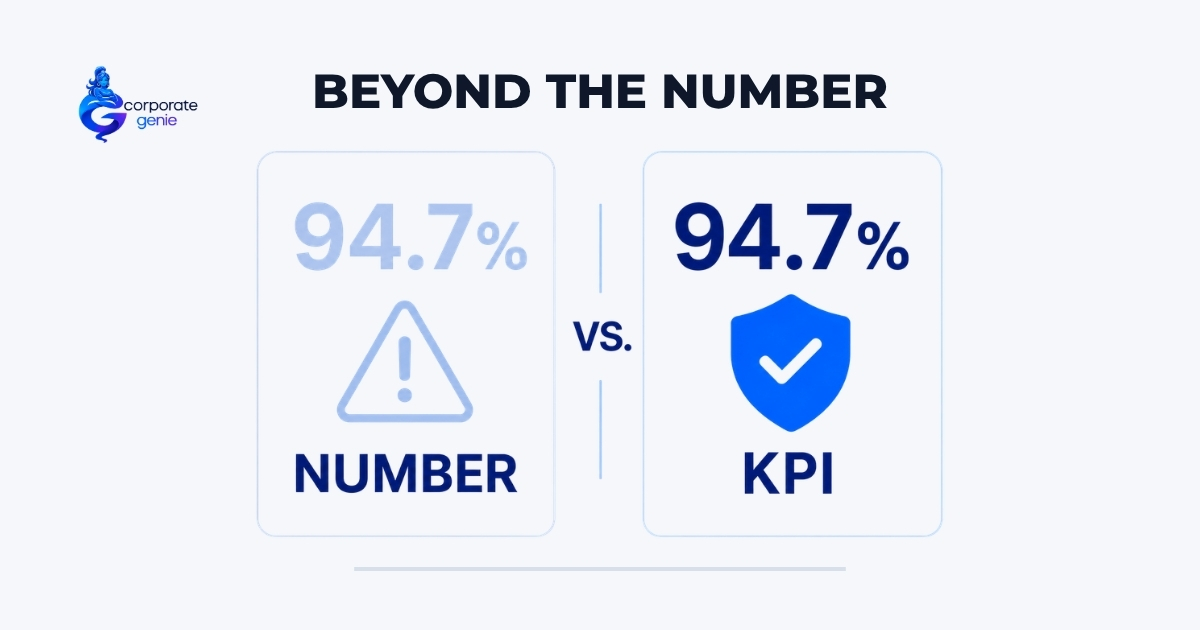
A KPI is not only a number. In addition to being a number, it's the definition of that number, its owner, its source, its time period, and the authority that says this version is the one the business agrees on. If you strip any of these away, what remains is a figure that looks reliable but carries no guarantee that it means the same thing to people asking and the system answering.
This distinction matters less when humans are doing the analysis. Experienced employees carry a lot of that context in their heads. For example, the Finance director knows which definition of revenue the board uses; the operations lead knows which system is the authoritative source for delivery times. The context travels with the person, even when it was never written down.
Now, when AI enters the picture, that silent transfer of context stops. The model retrieves the number and returns it. It does not retrieve the meaning, the owner, the scope, or whether the definition was updated last quarter. And AI returns the answer with the same confidence regardless.
The same metric, four different answers
Here is a scenario that plays out more often than most companies admit. Four teams are asked for the same KPI ahead of a board meeting. Finance pulls from the system of record. Sales pulls from the CRM. Operations pulls from the dashboard they maintain. The board pack uses the number from last quarter's presentation because it was already formatted correctly.
The thing is that all four numbers are correct within their own context. None of them are wrong. But they are not the same number, and if anyone stops to ask why, the answer usually traces back to a definition that was agreed on informally, applied inconsistently, and never formally owned by anyone.
In a manual process, this surfaces as a slow and frustrating alignment conversation. When AI is asked to retrieve or report on that KPI, it makes a choice the business did not know it was delegating. It picks a source, returns a figure, and formats it cleanly. The number looks authoritative. There is no flag that says four versions of this number exist and nobody owns the definition. Gartner names inconsistency in data across sources as the most challenging data quality problem organizations face.
What AI retrieves when there is no context
The core problem is not that AI retrieves the wrong number. It is that AI retrieves a number without the context that would tell anyone whether to trust it. The number's definition, an owner, a time period, a source, and a current status are not decorative. They are what separates a metric the business can act on from a figure that happens to be available.
Take customer health as an example. If the number in the system is 87 out of 100, that tells you almost nothing useful on its own. Useful means what inputs go into that score, who owns the methodology, when it was last refreshed, and does the customer success team agree it reflects reality. If two source systems are producing different values for the same customer, and nobody has established which one governs, then an AI that returns 87 with confidence has done something subtly dangerous. It has resolved a conflict the business had not resolved, without telling anyone it did.
This is not a theoretical risk. It is the default behavior of any retrieval system that is not built around a governed KPI layer.
What a KPI needs before AI can use it reliably
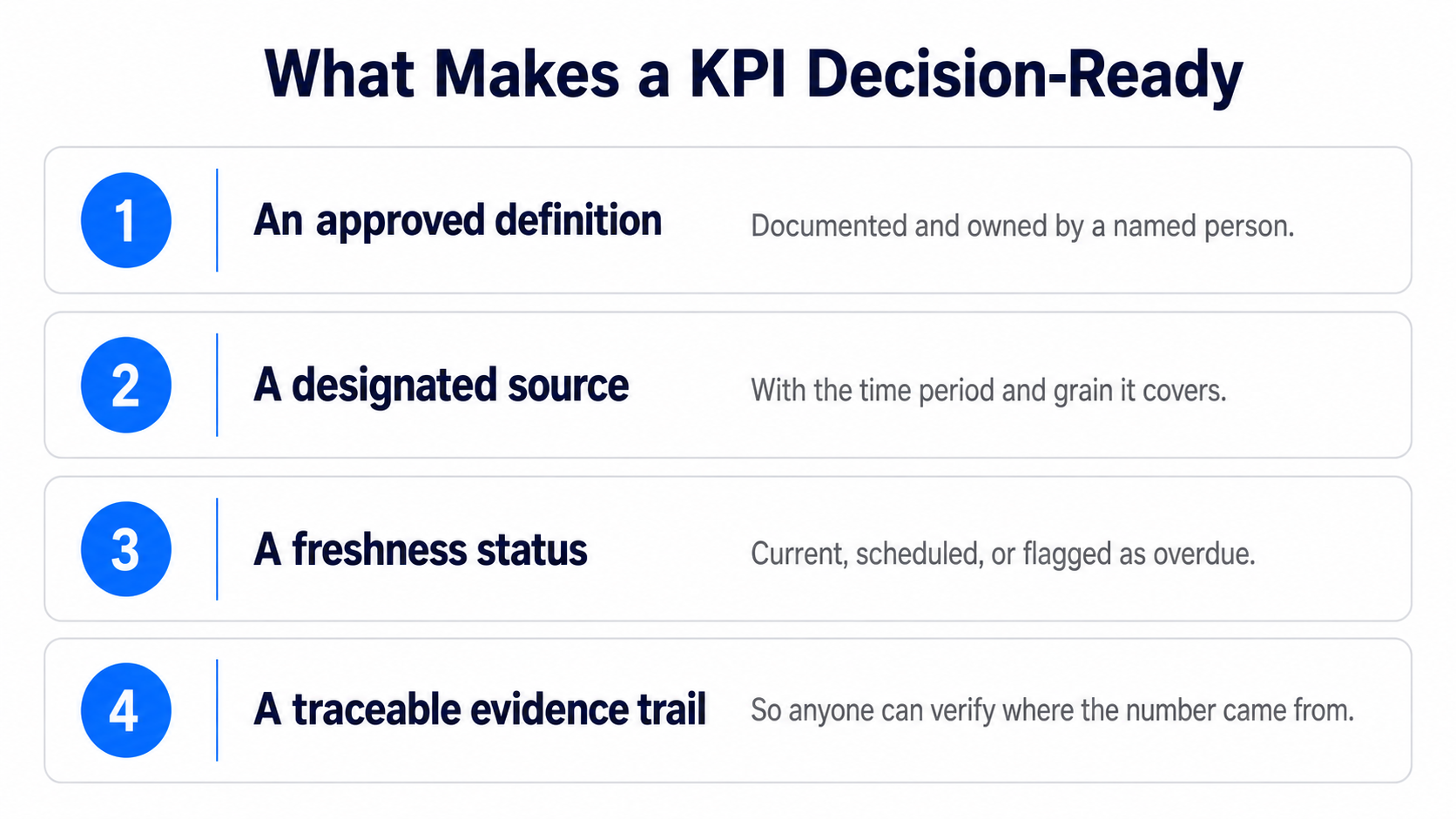
Making a KPI decision-ready means attaching its identity to the value, not just storing the value. That identity has a few consistent components.
First, a definition that has been approved by someone with the authority to approve it. Not a working assumption, not a convention that Finance and Sales have interpreted differently for three years, but a documented definition with an owner who can be named.
Second, a source that is clearly designated as authoritative, along with the time period and grain it covers. Revenue this quarter at the customer level is a different thing from revenue this quarter at the segment level, and both are different from what was budgeted. Establishing which source governs for which purpose is a decision most companies have deferred indefinitely.
Third, a freshness status that says whether the number is current, scheduled for a refresh, or overdue. A metric that was accurate three weeks ago and has not been updated is not the same as one that is live. The difference matters enormously when a decision is being made today.
And fourth, evidence that links the number back to its sources, so that anyone using it can trace where it came from without reverse-engineering the pipeline.
When these things travel with the number, an AI system can do something that changes the character of the answer. It can surface not only the value, but its authority, its scope, and whether there is a conflict that needs a human to resolve before the answer travels further. The CorpGenie KPI layer was built around exactly this idea: a number becomes decision-ready when its definition, source, scope, and owner travel with it.
When a conflict is more useful than a clean answer
One of the more useful things a well-built KPI layer can do is detect when two sources disagree and hold the answer rather than collapsing the conflict into a single figure. This is not a failure mode. It is information the business needs.
If Finance and Operations are both tracking renewal rate in EMEA and arriving at different numbers, that gap is not noise to be averaged away. It is a signal that the definition, the source period, or the customer scope is being applied differently in two places. The gap is the decision. Surfacing it and routing it to the people who can resolve it is more valuable than producing a clean answer that hides the disagreement.
This is what changes when KPI truth becomes a governed layer rather than an assumption the business makes and rarely examines. The answer the AI returns carries its own evidence. Conflicts are visible before they travel. The business can act on a metric with confidence, because the confidence has a foundation.
A number that knows what it means
Every company already has KPIs. The question is whether those KPIs carry the context needed to make them trustworthy when AI retrieves and uses them at scale. A number without an owner, a definition without authority, a source without a freshness status: these are not minor gaps. They are the conditions under which a capable AI system quietly makes decisions the business thought it was still making itself.
The companies that get this right not only have cleaner data, but they also have KPIs that know what they mean, who owns them, and whether they are ready to be acted on. That is a different category of asset, and it is the foundation any AI investment needs to work from.
Access to a capable AI model is no longer the hard part. The hard part is making sure the knowledge that model draws on is governed well enough to be trusted. For KPIs, that work starts with a simple question: does this number know what it means?