
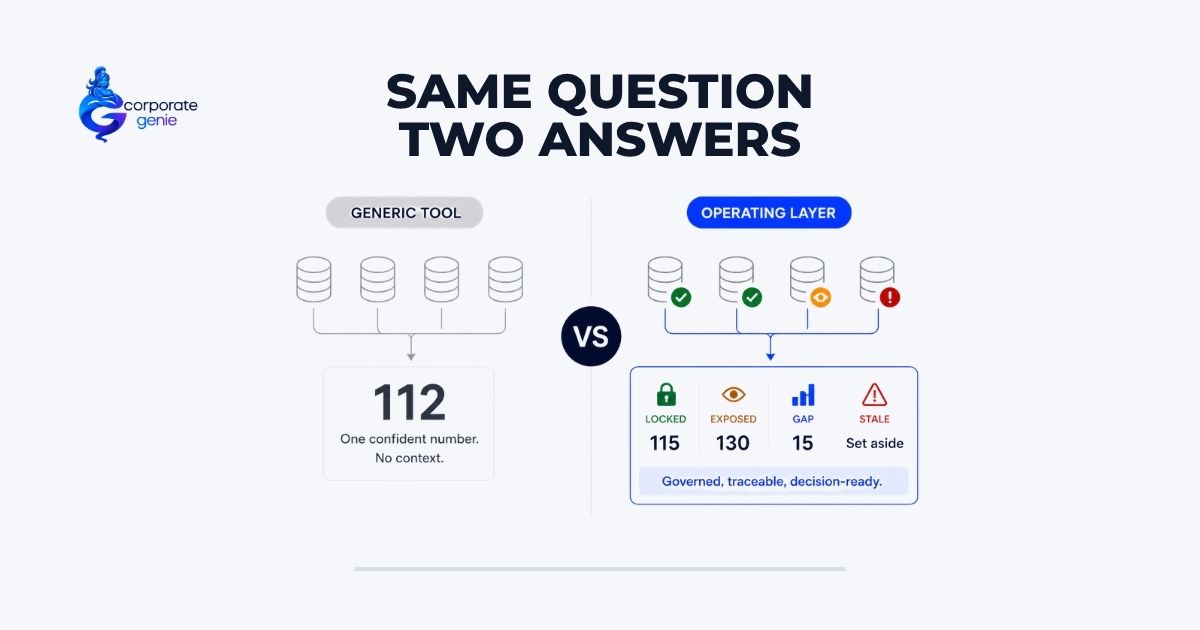
Company-specific AI is working when a business under pressure can get to a trustworthy answer fast. Not a fluent answer, a trustworthy one. When costs move suddenly, when numbers conflict, when the decision cannot wait for another alignment meeting. That is the test. And it is when the difference between a generic tool and a real operating layer stops being theoretical.
The clearest way to see it is in the moments when a business is under pressure and has to decide quickly, because that is when the difference between a generic tool and a real operating layer stops being theoretical.
Volatility is a good test. When costs move suddenly, when a market shifts overnight, when the numbers everyone relied on yesterday are wrong today, the company that can get to a trustworthy answer fast has a real advantage over the one still arguing about whose spreadsheet to believe.
Four numbers, all correct, but no decision
Picture a company hit by a sudden cost shock. Energy prices jump 15% in a week on the back of a geopolitical event. The CEO asks a simple question: what is our exposure?
Four departments answer, and each pulls the number they work with. Finance gives the actuals from the system of record, the cost as recorded. FP&A gives the figure from the planning model, the cost as budgeted. Sales gives the number reflected in current customer pricing. Procurement gives the cost locked into hedged supplier contracts, which is different again.
All four numbers are correct in their own context. None of them is wrong. But they are not the same number, and the result is a familiar one: a series of alignment meetings where everyone defends their figure and no decision gets made. Anyone who has sat through a planning cycle under pressure knows exactly how this goes.
But there is something else going on that nobody has caught. The planning model still carries last month's energy assumption, because the analyst who updates it is on leave. The file looks current: it was opened this morning, it is in the right format, and the number inside looks plausible. Nothing on the surface says it is out of date.
Why a generic tool won't help
It is tempting to think a capable AI assistant solves this instantly. Point it at the company's files, ask it the same question, and let it sort out the answer.
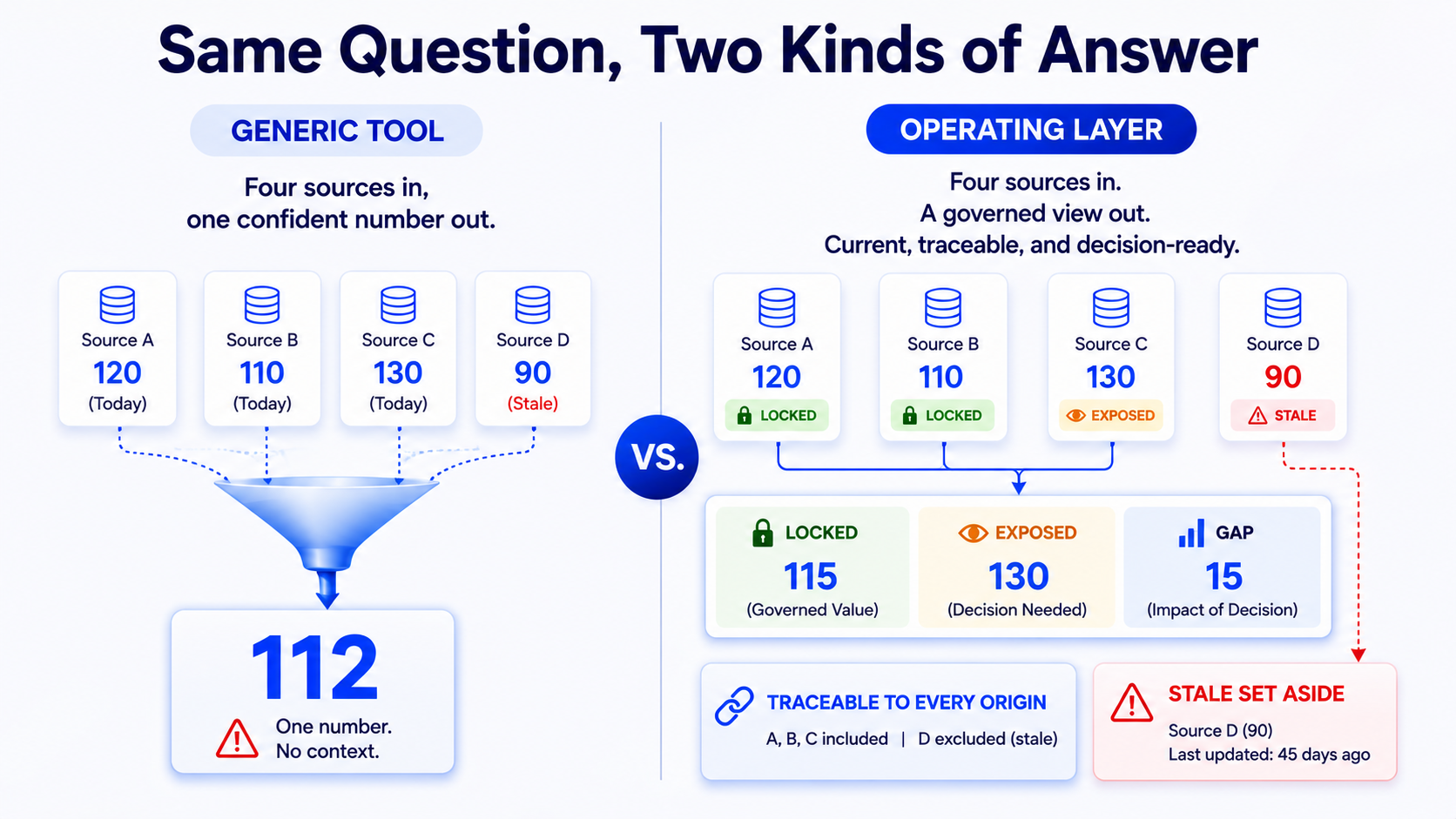
In practice, a generic tool tends to make the problem worse. It retrieves all four numbers and presents them as options, which is the same standoff the meeting was already having, now with a machine in the middle. Or it picks the most recent file by date and answers confidently, which means it may well pick the stale planning model, because nothing on the surface told it the number was out of date. Or even worse, it averages the four into a single figure that is tidy and confident, but is meaningless.
In every version, the tool does what it was built to do: produce a fluent answer. What it cannot do is know which source carries authority, know that one of them is quietly out of date, or recognize that a single clean number is the wrong thing to hand back at all.
When refusing to answer is the right answer
Here is what a properly built operating layer would do instead. Interestingly, the most important move is the one that looks least like what you asked for.
It would decline to give a single number. Producing one number would hide the gap the CEO needs to see and act on. The gap between what is contracted, what is budgeted, and what is actually being incurred is not noise to be averaged away. That gap is the decision.
So, instead of one figure, it returns the structured picture:
- Here is the cost locked in by hedged contracts and how long that protection lasts.
- Here is the actual cost now being incurred.
- Here is the exposure that sits between them, which is the part that needs a decision.
- And here is a flag: the planning model figure has been excluded, because its scheduled update is overdue and it has not been verified. The system knew the model's update cadence and knew the sign-off was missing, so it set that number aside rather than letting it quietly corrupt the answer.
A generic tool is built to always answer. An operating layer knows when the honest answer is "not one number, and here is why." That restraint is not a limitation. It is the whole point. The simple answer everyone wanted would have been the wrong one to act on.
When the board challenges the figure, a traceable answer settles it in under a minute
The payoff comes the next morning, in the board meeting. The CEO presents the exposure and the decision it requires. A board member challenges the figure, as board members should.
In the old world, this is where it gets uncomfortable. The honest answer is "we believe it is accurate," and the conversation turns into a debate about whose source to trust. With an operating layer, the figure carries its own lineage. It shows which source each part came from, when each was last verified, which one is the official system of record, and that the unverified planning number was deliberately left out and why.
The CEO does not defend a number. He explains where the answer came from and what was left out. The challenge is settled in under a minute, because the answer is traceable. That is accountability built into the system rather than reconstructed after the fact, and in a high-stakes meeting that is the difference between a decision that holds and one that falls apart.
This is what the operating layer is for
None of this comes from a smarter model. It comes from the operating layer this series has described from the start: trusted sources that carry authority, rules about when to answer and when to hold, and accountability that travels with every answer. The volatility scenario simply makes the value visible, because pressure is when the difference shows.
And it compounds. The company that built this for finance can extend it to procurement, to sales, to operations, each one faster than the last because the foundation is already there. What began as a way to answer one question under pressure becomes the way the company makes decisions across the board. The model underneath can change. But the judgment the company has built into the system will stay.
The future of AI is company-specific
Throughout this series, the argument has been a single one. Generic AI knows the world but not your business. The companies that win with AI are the ones that build the context, the governance, and the judgment that make it understand the company it serves. That is the operating layer, and it is available to every organization willing to build it.
The companies that start now will spend the next few years compounding an advantage that gets harder to catch. Not because they bought a better model, but because they built something that knows their business, and put it to work where the decisions are hardest.