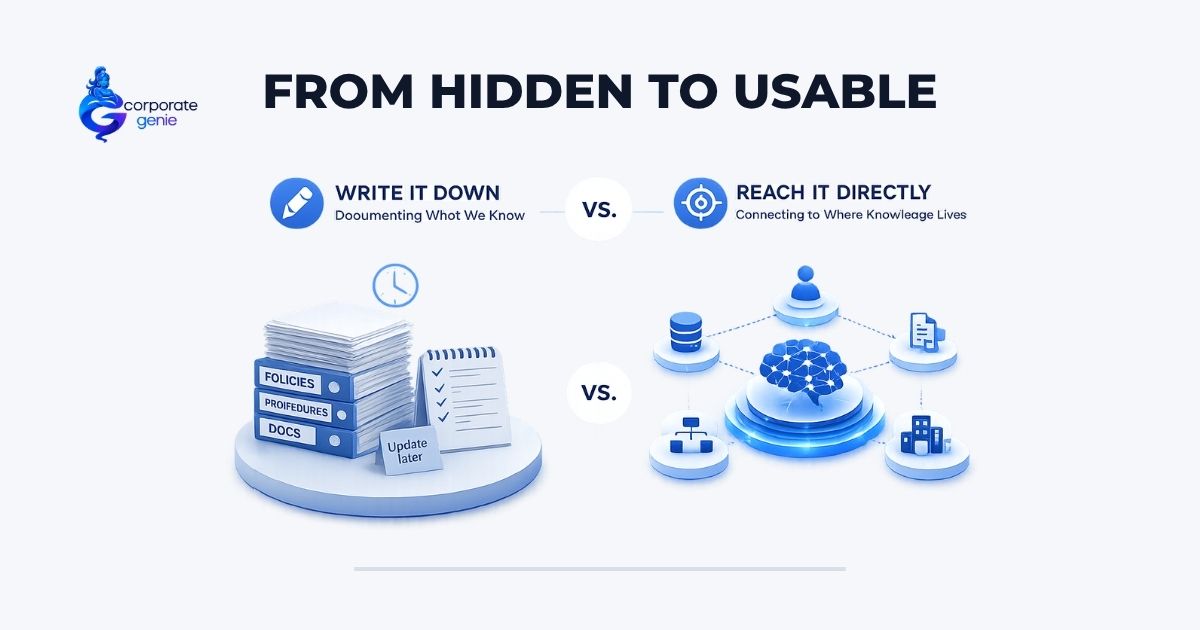
Deloitte estimates institutional knowledge loss costs U.S. companies $1.3 trillion a year. The average employee now stays in a role for just 4.1 years. Every time someone leaves, judgment, context, and history walk out with them. The standard response, document everything, has a ceiling. Documentation captures what people remember to write down when they are writing it down. The answer is to reach knowledge where it already lives, not transcribe it into documents.
The natural next question is a practical one. If most of what a company knows is submerged, how do you bring it within reach?
The honest answer is that you don't write it all down. That approach has been tried for decades and it doesn't scale. Documentation goes out of date the moment it's finished, and most valuable knowledge was never going to be written down in the first place. The real answer is different, and in fact more achievable than most leaders expect.
Why writing everything down is not the answer
For decades, the standard advice for capturing institutional knowledge was to document it: write the playbook, build the wiki, or record the process. This helps to some extent, and it is worth doing. But it has a ceiling.
Documentation captures what people remember to write down when they are writing it down. It often misses the judgment behind a decision, the exceptions nobody thought to mention, and everything that changes the week after it's published. Deloitte estimates that institutional knowledge loss costs U.S. companies $1.3 trillion a year, driven in part by a workforce where the average employee now stays in a role for just 4.1 years. The gap between what's documented and what people really know never closes. It always just moves apart.
The more promising approach is not to transcribe the submerged knowledge into documents. It is to connect to it directly, where it already lives, and make it usable the moment someone needs it.
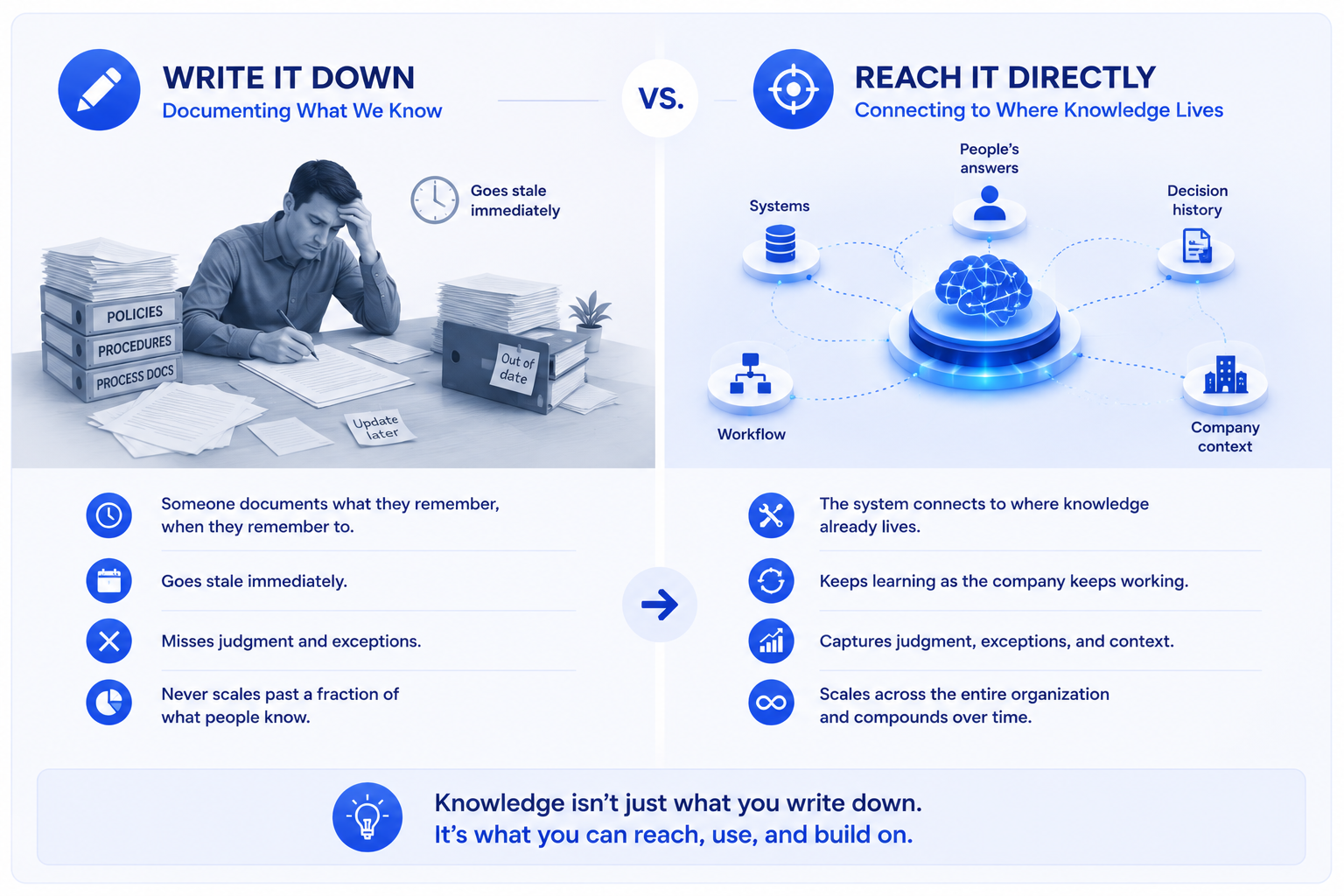
Knowledge held by people, scattered across systems, buried in history – each is reachable without documentation
Companies making real progress are working with the four places where knowledge lives, rather than trying to force it into one document.
Knowledge held by people. This is reached by capturing it as it is used, not by asking someone to sit down and write a manual. When an experienced employee answers a question, resolves an exception, or makes a judgment call, that moment is a source of knowledge. And it can be captured and made available for the next person who faces the same situation.
Knowledge scattered across systems. This is reached by connecting to the systems directly rather than exporting everything into one master file. The CRM, the reporting tool, and the inbox can each stay where they are; what matters is that the full picture can be assembled from all of them when a question is asked.
Knowledge buried in history. This is reached by preserving context alongside decisions, not only outcomes. For example, why a certain choice was made, what was tried before, and what happened last time are all recoverable if the system is built to keep that context attached rather than letting it disappear once a decision is closed.
Knowledge embedded in how work happens. This is reached by observing the workflow itself, including who approves what, which exceptions are routine, how something gets done in practice versus how the process document says it should. This operating knowledge becomes visible when the AI is built into the workflow rather than sitting outside it.
None of these four require perfect documentation first. They require a system built to reach knowledge where it already lives, and to keep learning as the company keeps working.
Reaching tacit knowledge safely requires the same operating layer as everything else in this series
Reaching below the surface is not a separate project from building a governed, company-specific AI system. It is the same one. The deeper the knowledge, the more it matters who is allowed to see it, which version is current, and who is accountable for how it gets used.
A customer conversation held in someone's memory may contain details that should only reach certain roles. A decision buried in old email threads may reflect a policy that has since changed. Reaching this knowledge without the trusted sources, the permissions, and the accountability this series has described throughout is how a company ends up surfacing the wrong thing to the wrong person at the wrong time. Reaching deeper is only valuable if what surfaces is trustworthy.
But this is good news, not a complication. It means the work that we already described in this series (starting narrow, building the operating layer and getting the right area ready first) is the same work that lets a company safely reach its deepest knowledge. There is no separate track to build.
The compounding value of institutional knowledge
Something changes as a company reaches further below its own surface. Knowledge that your company lost when employees left can now stay. Judgment that used to live in one person's head becomes available to the whole team. Decisions that used to repeat old mistakes start to draw on what happened last time.
This compounds in the same way everything else in this series compounds. Each piece of knowledge made reachable makes the next answer better, for everyone, going forward. A company that has been doing this for a year does not just have a system that answers questions. It has an organization that knows more about itself than it did before, and it knows it more reliably than any single person ever could.
The knowledge is already there
The best thing is that nothing in this process requires a company to create new knowledge. It already exists, in the people, in the systems, in the history, and in the daily work. The task is building something that can reach it, respect it, and put it to work safely, for the people who are supposed to have it.
That is the real opportunity beneath the surface of every company. Not a problem to be solved, but value that has been there all along, waiting for a way to reach it.
If you're thinking about how to reach this inside your own company, let's talk.