Every company knows far more than it can use. The policies and documents that are written down and easy to find are only a small part of what an organization knows. The rest, the vast majority, lives deeper: in workflows, in history, in the judgment of experienced people, in how decisions have been made a hundred times before.
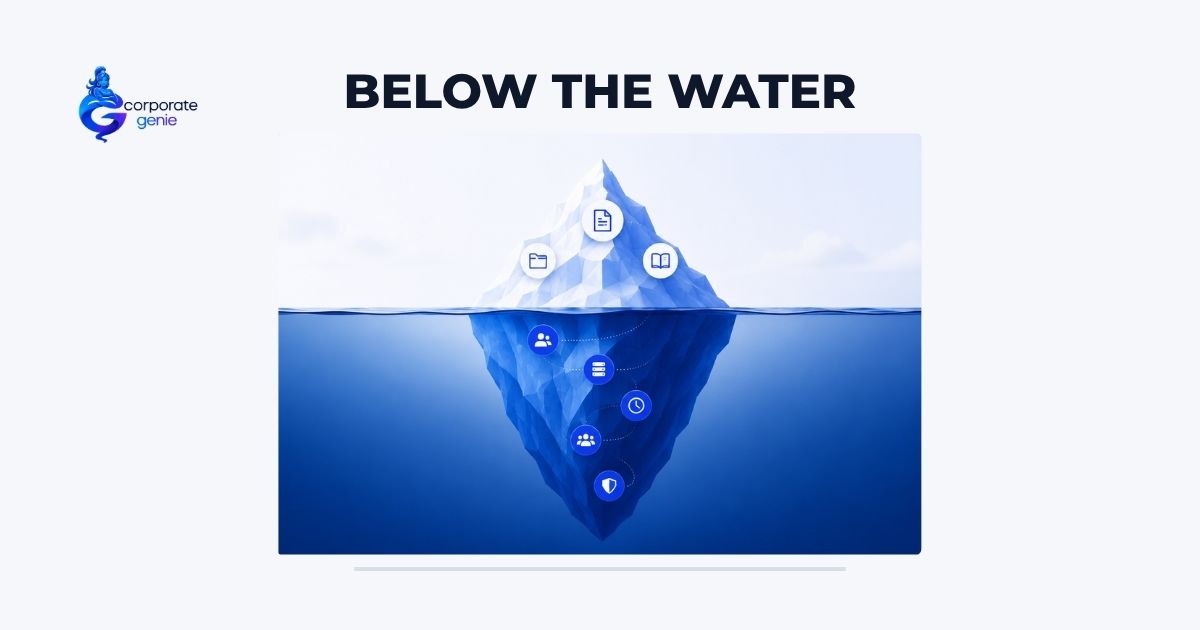
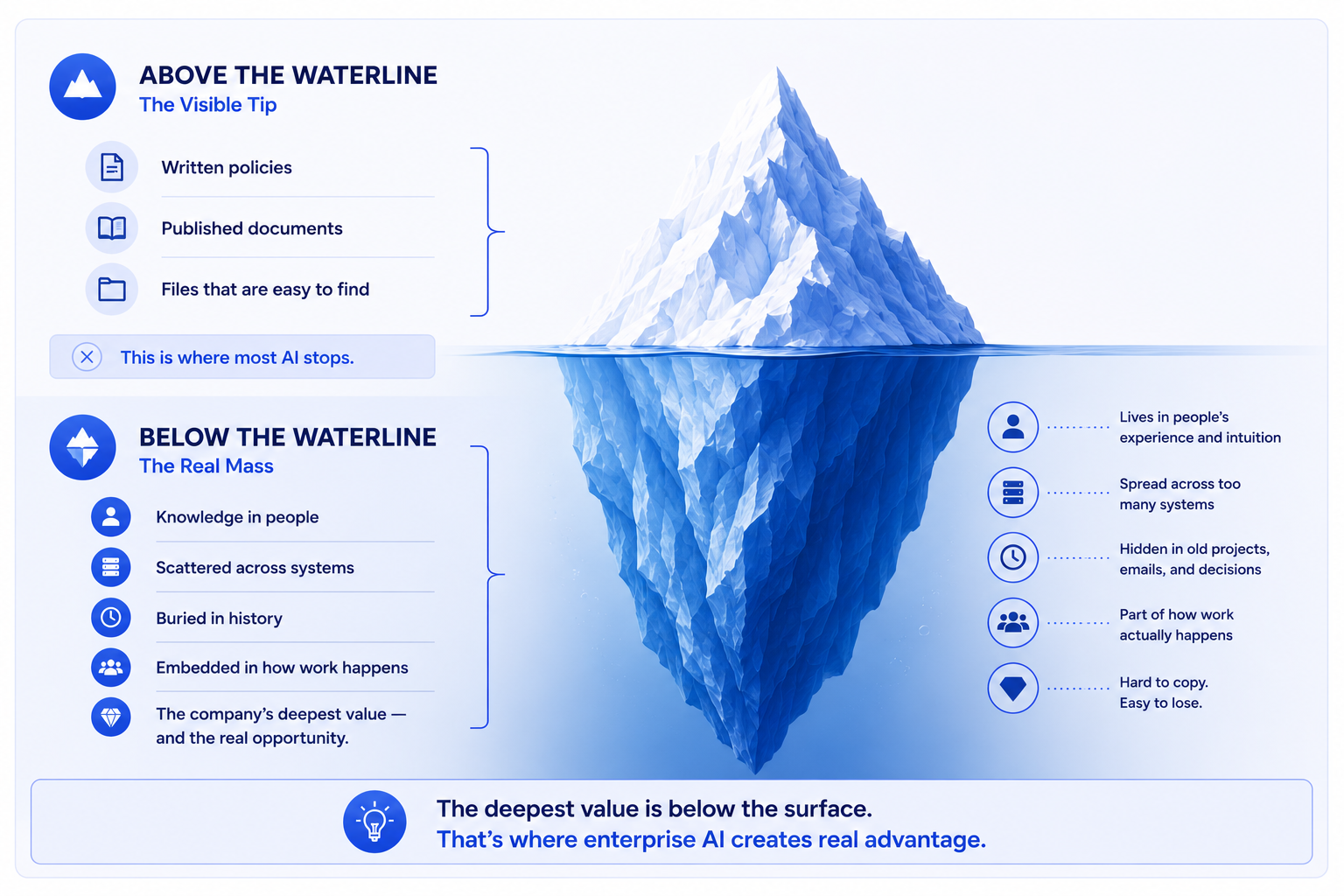
Think of it as an iceberg. The part above the waterline is visible and obvious. But most of the mass sits below the surface, out of sight.
For a company, that submerged part is not a problem. It is the most valuable thing the organization owns. And for the first time, it is becoming reachable.
Most AI only touches the tip
When a company points a generic AI tool at its information, it usually reaches the tip of the iceberg. These can be a published handbook, a policy document or files that happen to be easy to find. These are genuinely useful, but that's where most AI efforts stop.
But the tip is the smallest part of what the company knows. It is the part that was easy to write down and easy to access. The real knowledge that runs the business, like why a certain decision was made, what a customer was promised, which approach worked last time and which one failed, mostly lives below the waterline.
This is why a generic tool can feel impressive and still fall short. It is working with a fraction of what the organization knows, and often not the most valuable fraction.
What lives below the waterline
The submerged part of the iceberg is where a company's real intelligence lives. It takes a few forms.
Knowledge held by people. The experienced manager who knows why the process works the way it does. The salesperson who remembers what this customer cares about. This knowledge is real and valuable, but it is rarely written down.
Knowledge scattered across systems. The same fact lives in the CRM, the reporting tool, and three inboxes, in slightly different forms. The full picture exists, but no single place holds it.
Knowledge buried in history. Why a decision was made, what was tried before, and how a situation was handled last time. The context that makes today's decisions better is often locked in the past.
Knowledge embedded in how work happens. The unwritten sequence of who approves what, which exceptions are allowed, how things get done. This is the operating knowledge of the company, and almost none of it is in a document.
None of this is a weakness. Every successful company accumulates this kind of deep knowledge; it is a true sign of experience and maturity. The opportunity is not to fix it, but to reach it.
Gartner's research on enterprise knowledge management estimates that 70 to 80 percent of what a company knows is tacit, meaning it exists in people's experience rather than in any written form.
Why this is the business opportunity
For most of business history, the knowledge below the waterline was simply out of reach at scale. You could hire experienced people and hope they shared what they knew. You could write more of it down, slowly, and watch it go out of date. There was no practical way to make the whole submerged mass useful across the organization.
However, this is now changing. Company-specific AI, when built well, can reach beneath the surface. It can draw on the scattered systems, the history, and the operating knowledge, and make it available in the moment a decision is being made. Not replacing the experienced people, but making what they know available to everyone who needs it and when they need it.
A company that reaches its own submerged knowledge gains something it never had before: access to its full accumulated intelligence, on demand, across every team. That is a genuinely new capability, and it is the real prize in enterprise AI.
The companies that reach deeper will pull ahead
The advantage here is large and durable. Two companies can use the same AI model, but the one that reaches deeper into its own knowledge will consistently make better decisions. It is drawing on more of what it knows.
And this advantage compounds. The more of the submerged knowledge a company makes usable, the better every decision becomes, and the more valuable the whole system grows. It is the opposite of a generic tool that treats every company the same. It is an asset that gets richer the deeper you go.
The value was always there, but had to be extracted and used
The knowledge that makes your company what it is has always existed. It has simply been below the surface, hard to reach and impossible to use at scale. The opportunity in front of every organization now is to bring that submerged value up to where it can be used. This is done not by writing it all down, but by building AI that can reach it.
You always knew that the tip was never the point. The real value was always beneath it. And for the first time, it is within your reach with properly deployed company-specific AI.