
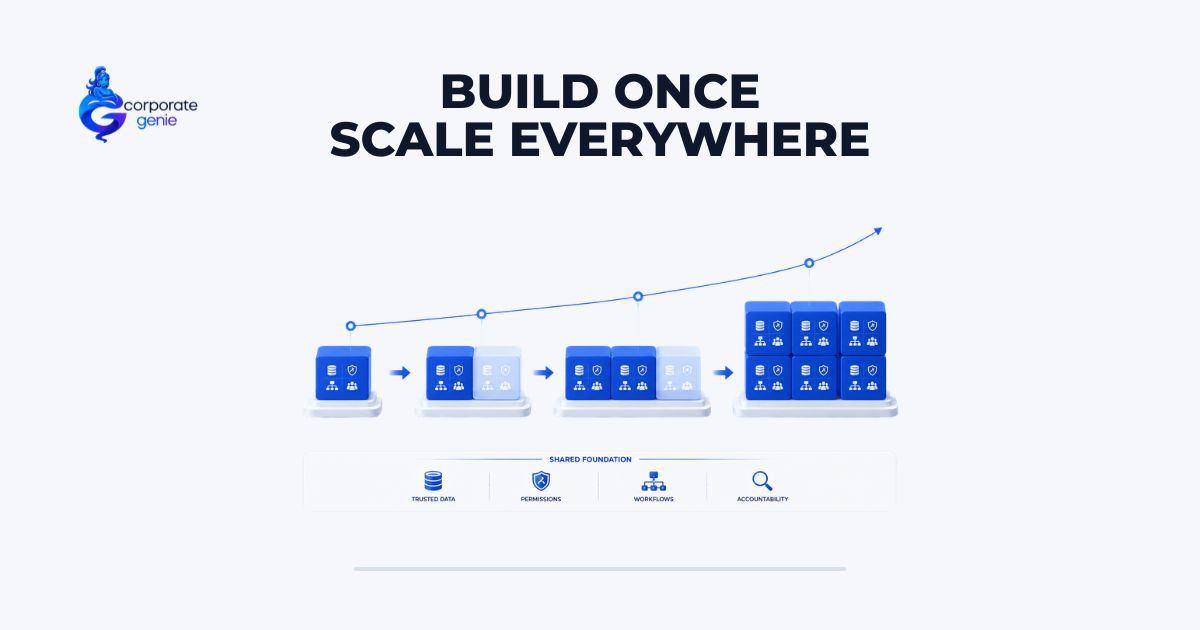
Nearly 70% of AI integrations fail because organizations cannot escape the pilot stage. The pilot succeeded. The expansion died. That happens when the pilot was built as a one-off, with its own data and no path to the rest of the company. The question is not whether to start small. It is whether to start in a way that goes somewhere.
That sets up a practical question every leader eventually asks. Where do we actually start?
Most companies answer it in one of two ways. Either they try to roll AI out everywhere at once, or they run a small pilot in one corner of the business. Both feel sensible. Both have a failure mode that is worth understanding before you choose.
The all-at-once trap and the pilot trap
Rolling out company-wide on day one is the riskier of the two. You commit budget, attention, and credibility before you have learned anything about how AI behaves inside your specific business. If something goes wrong, it goes wrong everywhere, and the whole effort can lose support before it has a chance to prove itself.
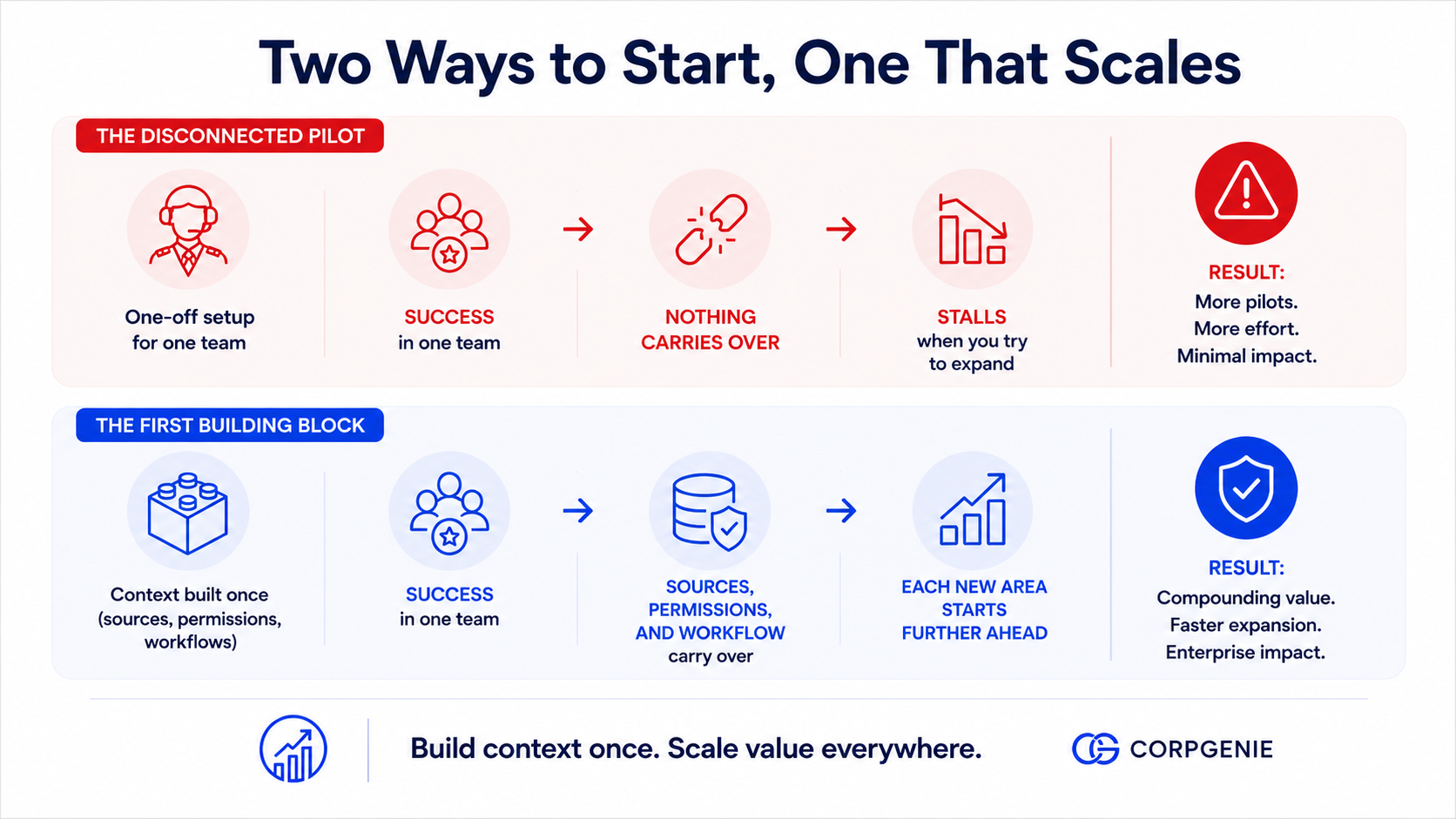
Therefore, most companies sensibly choose the pilot. And here they meet a different problem. A 2026 survey found that nearly 70% of AI integrations fail because organizations cannot escape the pilot stage. They run a successful proof of concept, celebrate the result, and then watch the momentum die when they try to scale it to the rest of the business.
This is the part most people miss. The pilot didn’t fail. It succeeded, but still went nowhere. That happens when the pilot was built as a one-off, with its own data, its own setup, and no path to the rest of the company. It proved AI could work in one room. It said nothing about whether it would work across the rest of the company.
Start narrow, but build it to scale
The companies that get this right have learned to separate two things that sound the same but are not: starting small and starting in a way that can grow. Starting small is easy. Starting in a way that can grow is the actual skill.
In practice, that means choosing one area of the business and building real context around the AI there. That context, often called the operating layer, is the set of things that make a model actually useful inside a company: the trusted sources it draws on, the permissions that shape who gets what answer, and the workflows it plugs into. You build it once, in one area, but you build it so the pieces carry over to the next area instead of starting from scratch.
Think of building a house. You don’t wire each room as if the others don’t exist. You lay the foundation, the electrical, and the plumbing so every new room connects to the same system. Company-specific AI works the same way. The first area you build should connect to the foundation the next area will use, not stand alone like a shed in the yard.
This is why incremental approaches consistently outperform company-wide launches. Not because small is safer, though it is, but because each step teaches you something the next step uses. You are not running disconnected experiments. You are laying the first section of a foundation the rest of the company will stand on.
The strongest first area has repeated decisions, a clear owner, and information you can put in order
Not every part of the business is a good place to begin. The strongest first candidates share four traits.
- Real and repeated decisions. Pick a place where the same kind of question comes up often, so the value shows up quickly and clearly. Reporting, approvals, and customer questions are common examples.
- Clear ownership. Choose an area where someone owns the outcome and can say what good (and bad) looks like. Context needs an owner, and so does the decision to expand.
- Information you can get in order. The data and documents should be reachable and possible to clean up, not scattered across systems no one controls.
- A measurable result. Decide before you start what success looks like, so the decision to scale is based on evidence, not enthusiasm.
A finance team’s quarterly reporting, a sales team’s discount approvals, a support team’s most common customer questions: each of these is bounded enough to build well and important enough to matter when it works.
Each step makes the next one easier
The real payoff of starting this way shows up later. The second area you build is faster than the first, because the trusted sources and the permission model already exist. The third is faster still. What began as one team’s project becomes the way the company runs AI, and the cost of each new step keeps falling.
This is the same compounding advantage we have come back to throughout the series, now seen from the implementation side. You are not buying a tool and switching it on across the company. You are building something that grows more capable and less expensive to extend with every area you add.
The first build is not just a win, it is the foundation every subsequent area inherits
The question was never whether to start small or start big. It was whether to start in a way that goes somewhere. A pilot that proves AI works and then dies has cost you time. A first building block that proves AI works and carries forward has started something.
Pick one area that matters, build real context there, and build it so the next area inherits the work. That is how company-specific AI gets built: not all at once, and not as a string of dead-end experiments, but one block at a time, each one making the next one easier.