88% of companies use AI. 60% see almost no real value from it. The gap is not access, nearly every organization has that now. The gap is the missing business context around the model. Companies that close this gap have stopped using AI as a personal productivity tool and started embedding it into how the whole company runs. That shift is what separates the organizations getting value from the ones still waiting for it.
However, there is a second number that tells a different story. BCG found that 60% of companies see almost no real value from their AI investments despite the spending.
Both figures are correct. And together they describe the gap that now defines corporate AI: nearly everyone has access to it, but very few are getting results.
The leading companies that are closing this gap are doing one thing differently. They stopped using AI as a personal productivity tool for individual employees, and started embedding it into how the whole company runs day to day.
That shift is what separates the organizations getting value from the ones still waiting for it.
Generic AI knows the world, but not the context of your company
A general-purpose AI model is trained on the public internet. It writes well, summarizes quickly, and answers almost any general question. For drafting an email or scanning through a call transcript, that is genuinely useful.
But companies run differently in real life. Businesses need answers that are, first and foremost, correct. These answers must reflect the company's current policies, data, customers, and processes. A generic model cannot really do that. It knows the world, but it doesn't know the internal context of your company.
This is why so many AI initiatives stall after a promising start. The model was never the problem. What holds it back is everything it doesn't know about the company around it.
Leading organizations build context around the model, not a better model
The organizations getting value have learned that AI doesn't fix a broken process. If you point a capable model at unclear data, conflicting policies, and undefined ownership, it will confidently produce wrong answers built on all of it. The model works exactly as it was designed. It surfaces every gap that was already there.
MIT Project NANDA's 2025 study analyzed more than 300 enterprise AI implementations. The pattern was consistent: the main blockers were poor data quality, weak workflow integration, unclear ownership, and limited business context. Importantly, it was never the quality of the model.
Leading companies understand that the opportunity was better context around the model, and that is something companies can (and should) build and own.
One question, four different correct answers
Here's what better context looks like in practice. Four people in the same company ask the same question: "Can we approve this discount?"
- The sales rep needs the approved discount range and the next step for sign-off.
- The sales manager needs the margin impact, the deal history, and whether this exception has precedent.
- The CFO needs the revenue recognition impact and the forecast implication.
- Legal needs the relevant contract terms and the compliance exposure.
One question, but four different correct answers. A generic AI would give one answer, the same fluent response to everyone, with no awareness of who is asking or what they're allowed to see. But a company-specific AI system understands the difference, because it understands context, and therefore, the business.
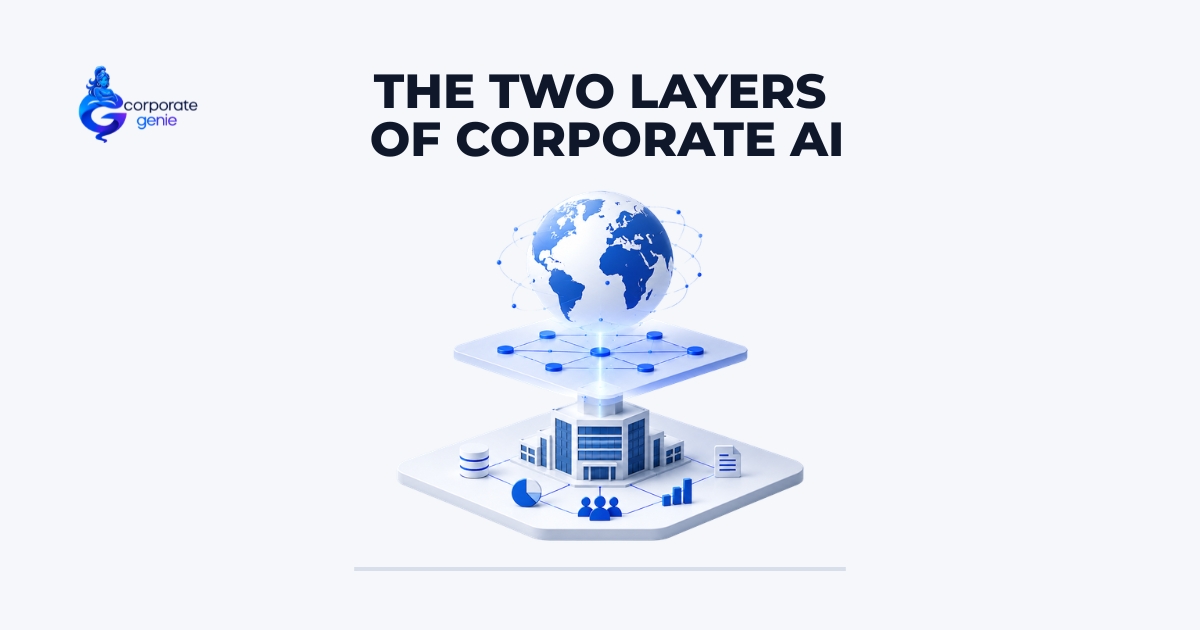
This is the main shift. The right answer in a company is not what is true. It is what is true, current, sourced, permitted, and relevant to the person asking. That is not a model capability. It is an operating layer the company builds around the model.
The operating layer has four practical parts:
Trusted sources, so the system knows which information is current and authoritative.
Role-aware permissions, so people receive only what they're cleared to see.
Workflow integration, so AI supports the places where decisions happen, including planning, approvals, reporting, and contract review.
Accountability, so every answer can show where it came from and how current it is.
Access was the first phase of AI, context is the second
The first wave of corporate AI was about getting the tool into people's hands. That wave is essentially over. Almost every company now has access.
The next wave is about context. What does the AI know about the business? Which sources does it trust? What is each person allowed to see? What decision are they trying to make? These are the questions that determine whether AI produces real value or just fast, well-written text.
The advantage here compounds. A company that builds trustworthy context once will improve every answer the AI gives after that, across every team, every workflow, every decision. The model can be upgraded or swapped over time. The context that the company builds is the part it owns.
The future of AI is company-specific
The companies getting value from AI are not the ones with access to the most advanced models. They are the ones building the context that makes AI understand their business: its sources, its people, its workflows, and its goals.
That is the opportunity in front of every organization right now. You don't need a better chatbot. You need a system that actually knows the context of the company it serves.