
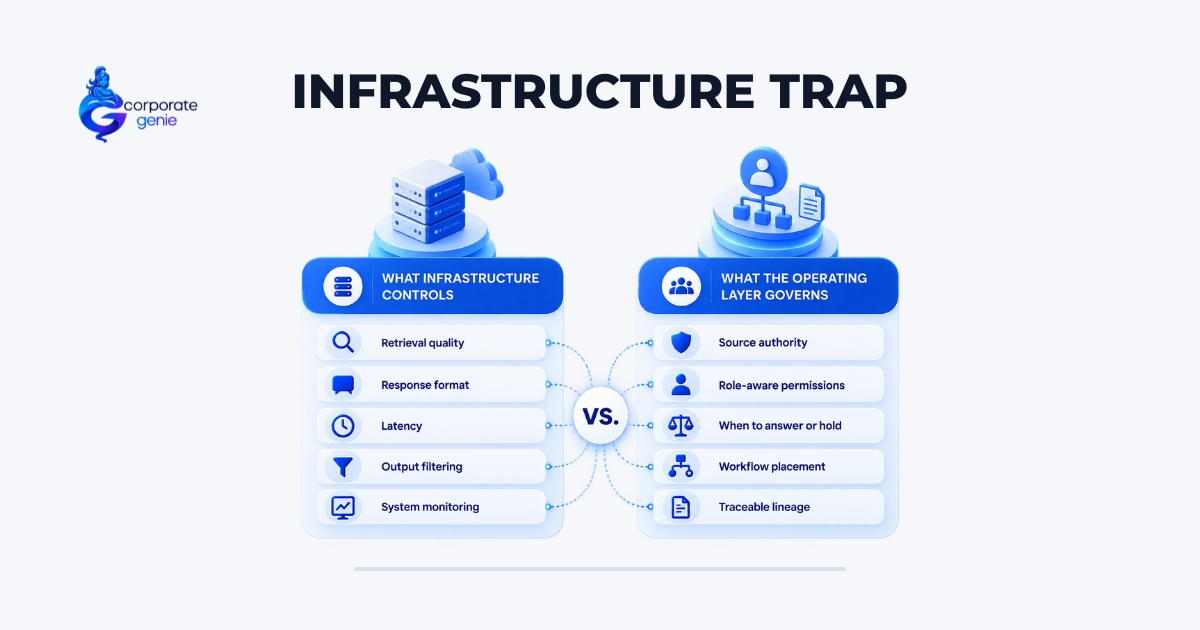
Companies usually approach corporate AI as an engineering project. They assemble components: a retrieval pipeline to search documents, a memory layer to hold context across sessions, controls to filter outputs, monitoring to track performance. Each piece is real and each solves a genuine technical problem.
This is the infrastructure trap. The system grows more capable and no more useful, because the infrastructure simply does not know the company it serves.
Companies keep adding components and the value stays flat
Often it happens like this. A team decides to build corporate AI. They start with document search and get inconsistent answers, so they add a ranking step. Then the system forgets context between sessions, so they add memory. It produces the occasional confident mistake, so they add output controls. Nobody can tell what it is doing, so they add monitoring.
Six months later the architecture diagram is impressive and the demo works. Then someone asks a question that matters and the answer cannot be used.
Every component in that stack is defensible in isolation. The problem is that none of them were built to answer the questions a business really needs solved. For example, which of these three documents is the current one? Is this person allowed to see this number? And should the system be answering this at all?
A complete technical stack can still produce an unusable answer
Picture a mid-size manufacturer twelve weeks into a corporate AI build. The stack is finished: ingestion works, search works, and the model responds quickly.
Then a procurement manager asks what the agreed lead time is for a key supplier. The system finds three documents. A master agreement from two years ago. A revised schedule attached to an email from March. A planning spreadsheet updated last week by someone in operations. All three contain a lead time and the numbers do not match.
The system returns the most recently modified file, because recency is the only signal it has. The spreadsheet was a scenario draft, never approved. The March revision is the one that governs. Nobody told the system that, because nothing in the stack was designed to hold that kind of knowledge.
The infrastructure did exactly what it was built to do: it retrieved, it ranked, and it generated the answer. What it could not do was know which source carried authority, recognize that the question touched commercially sensitive terms, or decide that the honest answer was to flag a conflict rather than pick a number.
That gap is not fixed by adding a seventh or even tenth component.
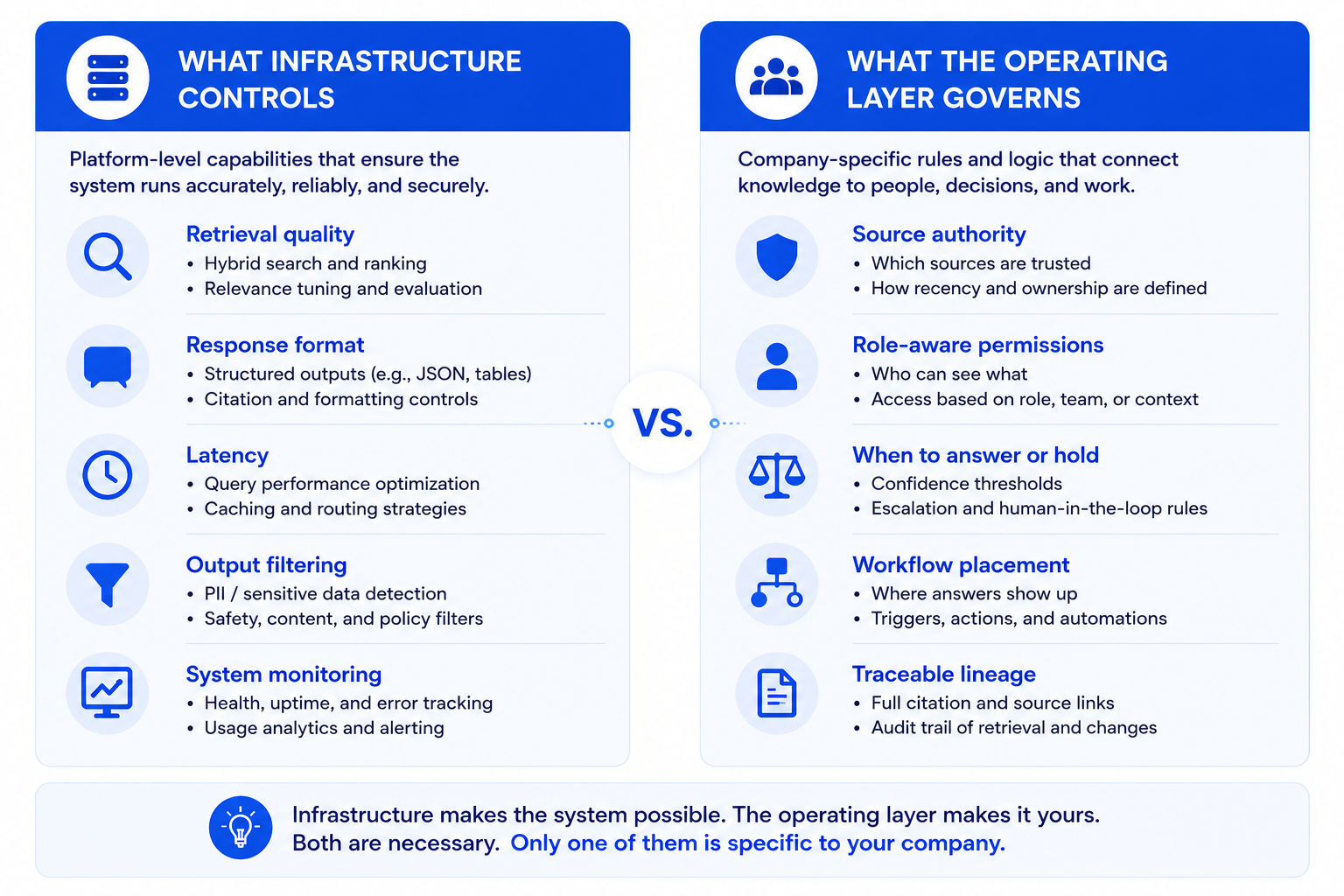
Technical controls check the output. Business governance checks the decision.
This distinction is where most corporate AI programs can stall.
Technical controls are useful. They catch a model that contradicts its own source. They can flag responses outside an expected format. They tell you when latency spikes or retrieval quality drops. They are quality control for the machinery.
Business governance answers a different set of questions. This includes the questions, like which source is the official record when several versions exist; what this specific person, in this role, in this department, is cleared to receive; when an answer should be routed to a human before anyone acts on it; and whether the figure that just left the system can be traced back to something a board member could verify.
No amount of monitoring produces source authority. No output filter produces role-aware permissions. These are decisions the business makes and encodes, and they sit above the infrastructure rather than inside it.
Gartner data shows governance is now the fastest-growing line in AI budgets, up from 3 to 5 percent of total spend two years ago to 8 to 12 percent today, and still the smallest piece of the pie.
We have covered why document retrieval alone is not enough and why customisation does not close the gap either. The same logic applies to the stack as a whole.
The smallest system with the right context beats the largest one without it
The encouraging part of this is what it means for cost and complexity.
If corporate AI were an infrastructure problem, the advantage would belong to whoever could afford the most sophisticated stack. However, it is not; therefore, it does not. A modest system connected to authoritative sources, shaped by real permissions, and wired into an actual workflow will outperform an elaborate one that knows none of those things.
This is the same argument the series has made about models. Model quality is converging and capable models are available to everyone. And infrastructure is heading the same way. Components that were research projects three years ago are now commodity building blocks.
What does not commoditize is the knowledge of how your company works: which sources are trusted, who holds which decision rights, how work actually moves through approvals. That knowledge is specific to your organization, and it is the part that determines whether any of the machinery produces something useful.
Start with the decision, then build backward
The practical shift is in sequence.
The infrastructure-first approach asks what the system should be able to do, then assembles components until the list is covered. It produces a capable system with no clear purpose.
The alternative starts with one real decision the business makes repeatedly. These can be what question gets asked, who asks it, what a correct answer looks like, which source settles it, and what has to happen before anyone acts on it.
Answer those five questions and the technical requirements resolve themselves. Most of the time the answer is far less machinery than expected, because the hard work has moved to where it belongs: defining the context, the authority, and the rules that make an answer trustworthy.
That work can seem unglamorous and it may not demo well. However, it is also the difference between corporate AI that impresses a room and corporate AI a business can run on.