
Only 7% of organizations say their data is completely ready for AI. Read that at face value and the conclusion looks grim. But complete readiness across the whole organization is not the prerequisite. It is a condition that does not exist, in any company, at any scale. The right question is not whether the whole organization is ready. It is whether one specific area is ready enough to build something trustworthy and useful there.
The question most leaders ask next is a practical one: are we ready to do this? The honest answer, for most organizations, is that they are closer than they think. But many companies misread what readiness means. Some wait too long, thinking they are not ready. Others move too fast, before the right foundations are in place.
In this article, we discuss what readiness actually means, what the research shows, and how to know and understand where your organization currently stands.
Most companies measure readiness across the whole organization. That is the wrong question
A 2026 Cloudera and Harvard Business Review study of enterprise data leaders found that only 7% of organizations say their data is completely ready for AI adoption. Read that at face value and the conclusion looks grim: almost no one is ready.
But that is the wrong question. Complete readiness across the whole organization is not a prerequisite for getting started. It is a condition that does not exist, in any company, at any scale. Waiting for it is the same as never starting.
Think of opening a restaurant. You do not need the perfect kitchen before you open. You need the right kitchen for the menu you are serving on day one. The health certifications, the supplier relationships, the trained staff for those specific dishes. None of that requires perfection everywhere. It requires the right things in place for what you are actually going to do first.
Corporate AI readiness works exactly the same way. The question is never whether the whole organization is ready. It is whether one specific area is ready enough to build something trustworthy and useful there.
Three conditions determine readiness: accessible information, clear ownership, and a definition of success
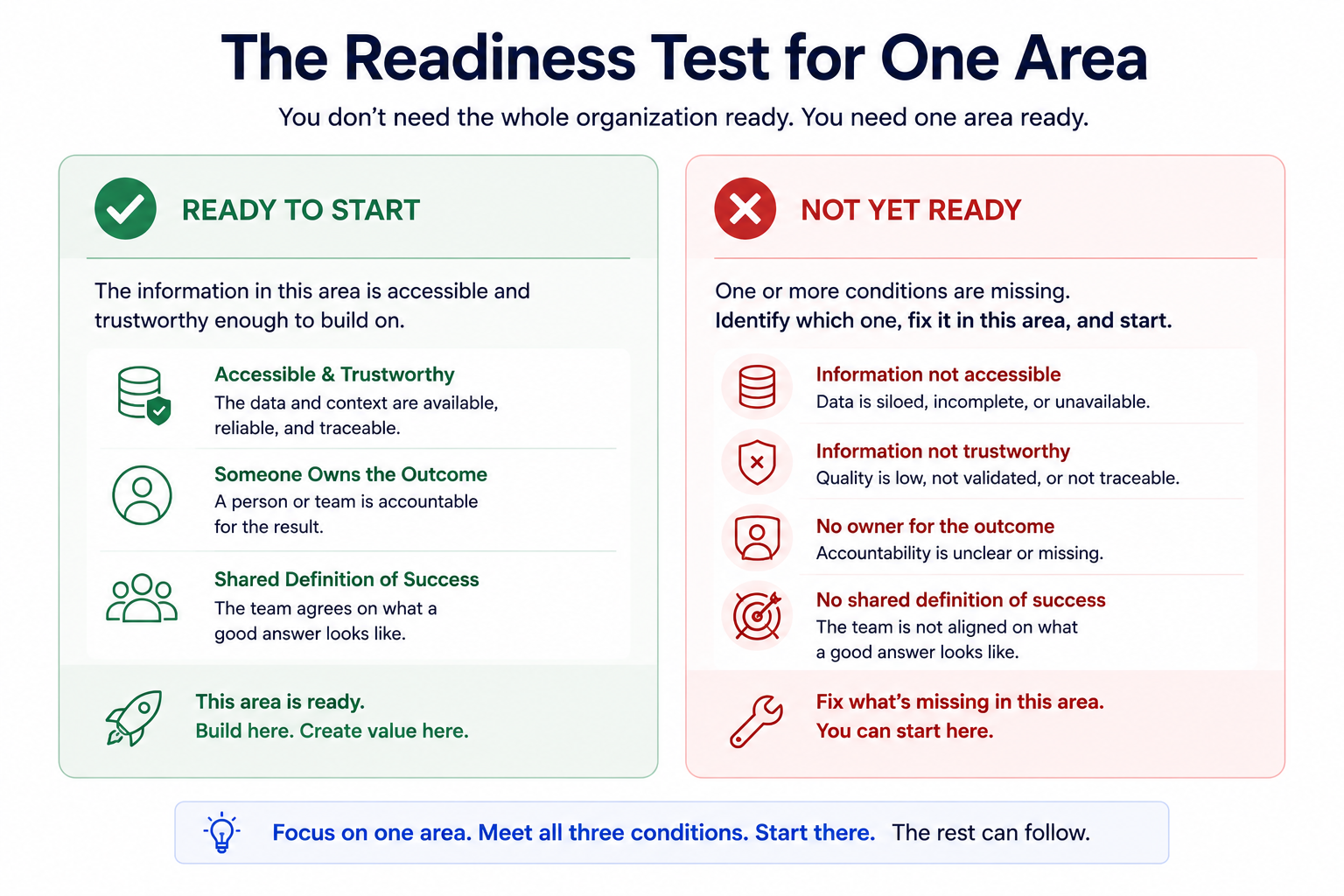
Across the research, three conditions consistently separate the organizations that start and succeed from the ones that stall. They are the same conditions that determine whether a first attempt to build works, regardless of how sophisticated the AI underneath it is.
Information that is accessible and trustworthy in that one area. Not across the whole company but in the bounded place you are starting. A Capital One survey of 500 enterprise data leaders found that 73% identified data quality as the primary barrier to AI success, ranking it above model accuracy and computing costs. But data quality is not a company-wide pass/fail condition. In most organizations, some areas have cleaner, more accessible information than others. The starting point is finding one of them.
Clear ownership of the outcome. Someone needs to own what the AI is trying to answer and be able to say what a good answer looks like. Without an owner, there is no one to validate the output, no one to flag when something is wrong, and no one to decide when the system is ready to expand. This is an organizational condition, not a technology one.
The ability to define what a good answer looks like before you start. This sounds obvious, but it's the condition most often skipped. If the team cannot agree on what success looks like for the specific question the AI will answer, the build will drift, the results will be contested, and the decision to expand will never arrive.
Back to the restaurant example: health certifications, trained staff, and a working kitchen for your menu. Different words, same idea. Get those three right in one bounded area and you are ready to start.
Two-thirds of organizations are already reporting AI productivity gains. The ones stalling scaled too fast
The picture from the research is more optimistic than the headlines suggest. Deloitte's 2026 State of AI in the Enterprise survey of 3,235 senior leaders found that two-thirds of organizations are already reporting productivity and efficiency gains from AI. Worker access to AI rose 50% in 2025. The organizations that are stalling are not stalling because the technology doesn't work. They are stalling because they tried to scale before the foundations were ready in the areas they chose.
The pattern is consistent with the approach this series has argued for: start in a bounded area where the three conditions are met, build the operating layer there, and expand from that base. Organizations that follow this sequence are not waiting until everything is perfect. They are making a deliberate choice about where to be ready first.
How to run the check in your organization
Pick the area you are most likely to start with. The one with repeated decisions, clear ownership, and information you believe is reasonably organized. Then run three questions against it.
Can we get the right information? Not all information, everywhere, but the specific documents, data, and policies the AI will draw on for this question. Is it accessible, is it current, and do we know which version to trust?
Does someone own this? Name the person. If the answer is a committee, a shared inbox, or "it depends," ownership is not clear enough. It should be a single person who can validate the output and decide when to expand.
Can we define what good looks like? Write it down before the build starts. What does a correct, useful answer to this question look like? If the team cannot agree on this in advance, they will not agree on it after the first output either.
If all three are answered clearly, you are ready to start in that area. If one is missing, it is fixable, and fixing it in one bounded area is a very different task than fixing it across the whole organization.
Readiness is a starting point, not a finish line
The restaurant does not need a perfect kitchen before it opens. It needs the right kitchen for what it is going to serve first. Every expansion after that is built on what the first service taught them.
The same logic applies here. Most organizations are ready to start somewhere. The work is finding that somewhere, getting the three conditions in place there, and building the first piece of something the rest of the company can grow from.