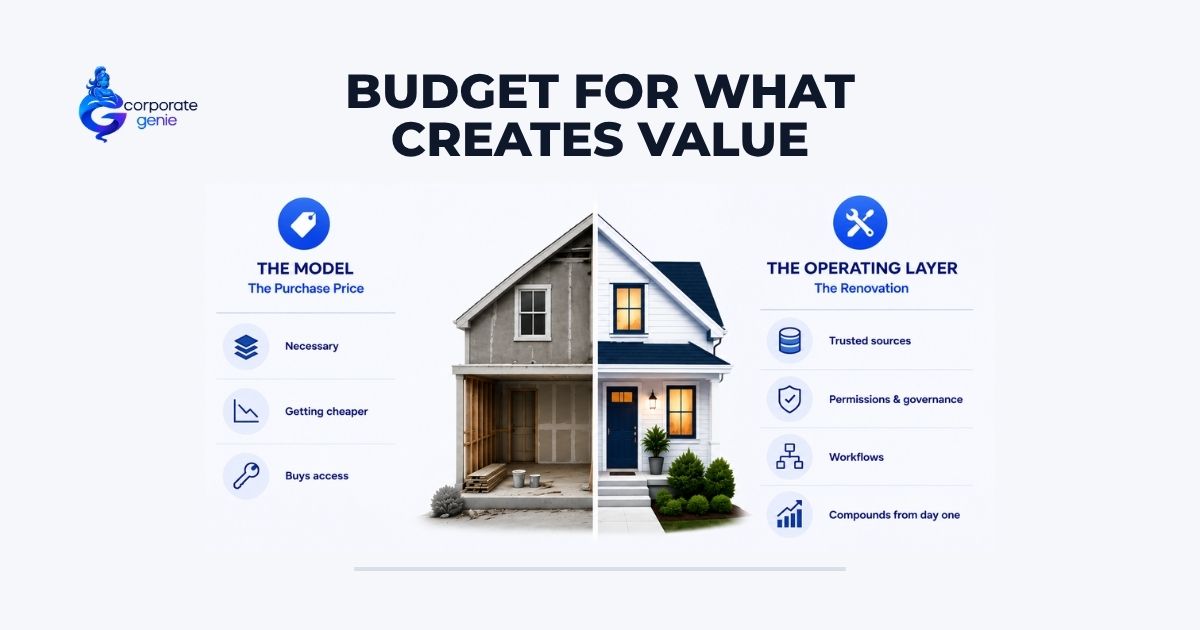
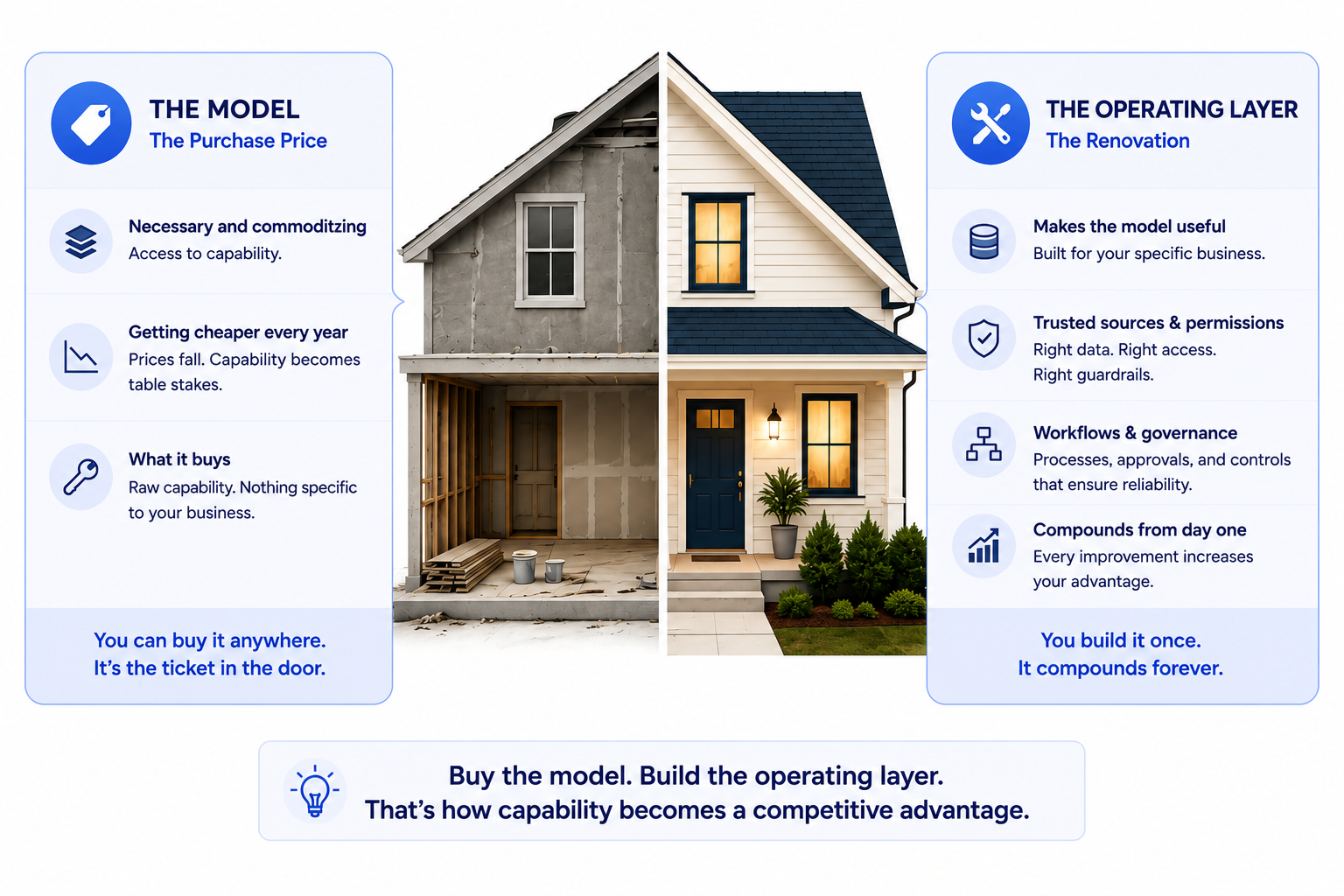
The AI model is the purchase price, necessary and getting cheaper. Gartner projects it will cost 90% less to run a large AI model by 2030 than it does today. The operating layer is the renovation, the work that makes the asset perform. Companies that budget for the sticker price and skip the renovation end up with an expensive asset that does not deliver. Understanding this structure is what makes the investment work.
The honest answer is the cost is real. However, the structure of cost is different from what most companies expect, and understanding it correctly is what makes the investment work. Many organizations budget too much for the wrong thing and too little for what creates value.
The model is the purchase, the operating layer is the investment
Let's take an analogy. Buying a house can have two prices. There is the purchase price, which is what everyone focuses on. And there is the renovation, the work that makes the asset livable and valuable. A house without renovation sits below its potential. The renovation is not an optional extra. It is what the asset is worth.
Company-specific AI has a similar structure. The AI model is the purchase price — necessary, and increasingly affordable. Model costs have fallen dramatically: API prices for top-tier models have already dropped to roughly one-tenth of their 2023 launch pricing.
And this trend will likely continue. Gartner projects that running a large AI model will cost 90% less by 2030 than it does today. The model cost is the part that keeps getting cheaper. That's a given.
The operating layer — the trusted sources, the permissions, the workflow integration, the governance — is the renovation. It is what makes the model useful inside a specific company. And like a renovation, skipping it doesn't save money. It just means the asset never performs to its full potential.
There is one important difference from the house analogy though. The renovation you invest in compounds. The operating layer you build now improves every answer the AI gives from that point forward, across every team that uses it. The earlier you invest in it, the longer it works for you.
How corporate AI budgets break down
Research on enterprise AI budget allocation in 2026 shows a consistent pattern across mid-market and large organizations. The breakdown typically looks like this:
- 30–40% on AI software and SaaS tools: the model access, the chat interfaces, the applications.
- 20–25% on cloud infrastructure.
- 15–20% on internal AI talent.
- 10–15% on implementation and consulting.
- 8–12% on data platforms.
- 8–12% on governance and security — the fastest-growing line item, up from roughly 3–5% in 2024.
The companies getting the best results are the ones whose budget allocation reflects where the value comes from. BCG's 10/20/70 rule, the most cited framework in enterprise AI investment, makes this point directly: 10% of AI success depends on algorithms, 20% on technology and data infrastructure, and 70% on people and processes: the operating layer, the change management, the workflow redesign. Programs that invert this, spending 80% on software and little on the operating model, consistently underperform.
The cost that surprises most companies
The single most common budget surprise in enterprise AI is the gap between what a proof of concept (POC) costs and what a production system costs. Research from 2026 found that moving from 90% to 99% accuracy (the difference between a demo and something a business can rely on) can multiply implementation effort by three to five times. A POC that cost $60,000 can become a $250,000+ production system.
This is not a failure of the POC. It is the cost of making it real. The POC proves that the approach works. But then the production build adds the reliability engineering, the monitoring, the governance, the source authority, the permission rules, and the workflow connections that make it safe to run a business on. That work is exactly the operating layer this series has described.
Companies that understand this going in make better decisions. They run a POC to validate the approach, then budget separately and deliberately for the production build. Companies that don't understand it experience the production cost as an overrun and often stall there.
Two companies, same model, same starting function, but completely different outcomes based on where they invested
Picture two companies in the same industry, starting their company-specific AI build in the same quarter. Both buy access to the same model. Both run a pilot in their finance function.
The first company spends most of its budget on the software license and a quick deployment. The pilot works, and analysts start drafting commentary faster. The team celebrates success. However, six months later, the pilot is still running in the same corner of the finance team, producing the same outputs for the same three people. Nobody knows whether the sources are current. Nobody has defined who owns the output before it goes to the board. The CFO doesn't trust it enough to use it without checking manually. The cost was real. But the value is still theoretical.
The second company spends less on the model and more on the operating layer: defining which sources are authoritative, setting up the permission rules, integrating it into the actual reporting workflow, and building in the review step before anything goes to the board.
The pilot takes a month longer (or even two months) and costs more upfront. But when it works, it actually works. The CFO uses the output directly. The team expands it to procurement the following quarter in half the time, because the foundation is already there.
Two companies had the same model and the same starting function, but very different investment structures and very different results. The difference is not the technology. It is what each company chose to spend on.
What the investment returns
Deloitte's 2026 State of AI in the Enterprise survey of 3,235 senior leaders tells a clear story. Two-thirds of companies are seeing productivity gains from AI. But only one in five are seeing actual revenue growth.
Most organizations are getting faster emails and cleaner reports, but not yet the business returns they invested for. The companies crossing that line are not spending more. They are spending differently, with the operating layer as the investment, not an afterthought.
The returns compound in the same way the costs do. The first area you build generates returns from day one. The second area is faster and cheaper to build because the foundation is already there. By the third area, you are extending an asset the company owns rather than rebuilding from scratch. The operating layer does not depreciate. It accumulates.
The model underneath can change. And it will change; it will become faster and cheaper each time. But the operating layer is the part that stays, improves, and compounds. This is what the investment is buying.
Budget for what creates the value
The model is the sticker price. It is necessary, and it is getting cheaper. The operating layer is the renovation, the work that makes the asset perform. Companies that budget for the sticker price and skip the renovation end up with an expensive asset that doesn't deliver.
The companies building durable AI advantage are the ones that understand this structure, budget for it deliberately, and start the renovation in one well-chosen area. From there, the investment compounds. Every area added makes the next one faster. Every answer the system gives makes the next one better.