
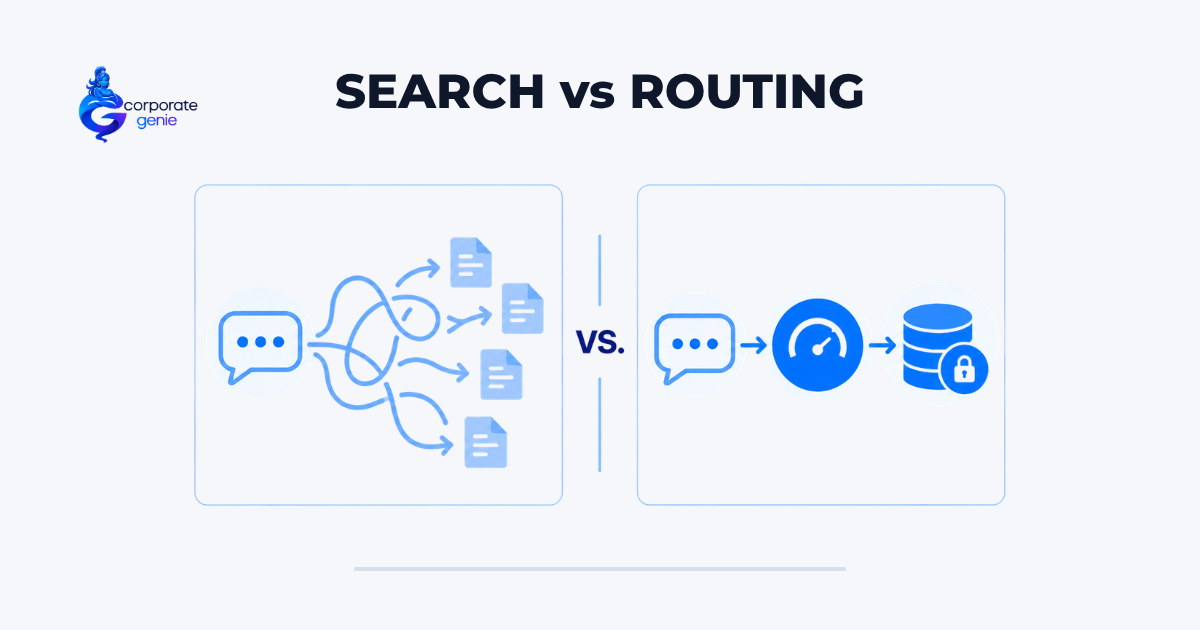
AI creates the most business value when it acts as an active orchestration engine rather than a passive search tool. By intercepting questions and routing them directly to governed systems of record, a company ensures its teams get precise, actionable data tailored to their specific roles.
The first wave of enterprise AI focused on access. Companies bought licenses and gave employees a new window to type questions into. The results were immediate but shallow. The next wave of enterprise AI is about context and control. It is about systems that actively orchestrate how a business uses its own intelligence.
The industry still treats enterprise AI like a highly capable librarian searching a massive folder of PDFs. This is a mistake. The intelligence of a corporate AI system lies in its ability to actively route queries to the right destination, not just its ability to read documents. When an AI searches everything, it returns answers stripped of the context required to make a business decision. When an AI uses a decision engine, it evaluates the intent of the question and securely routes the query only to approved, governed sources.
Moving from passive search to active orchestration
Most AI implementations rely on passive search. You ask a question, and the system fetches text from the most recent or most frequently accessed files. That approach works well for drafting emails or summarizing meeting notes. It fails completely when the business needs a mathematically accurate figure or a definitive policy answer.
Passive search places the burden of judgment entirely on the user. The AI retrieves five conflicting documents, and the employee must guess which one is the authoritative source. This is not enterprise intelligence; this is just a faster way to find a mess.
Active orchestration upends this model. Instead of treating every question as a search query, the system uses an orchestration engine to determine how and where to formulate the query. The system intercepts the prompt before the search happens. It stops being a passive retrieval tool and becomes an active traffic controller, ensuring the question only reaches the data source equipped to answer it accurately. When you shift the burden of routing from the human to the system, the speed of decision-making increases across the entire organization.
How a decision engine evaluates business context
A question asked inside a company is never just a string of words. It carries business context. A true operating layer evaluates that context immediately.
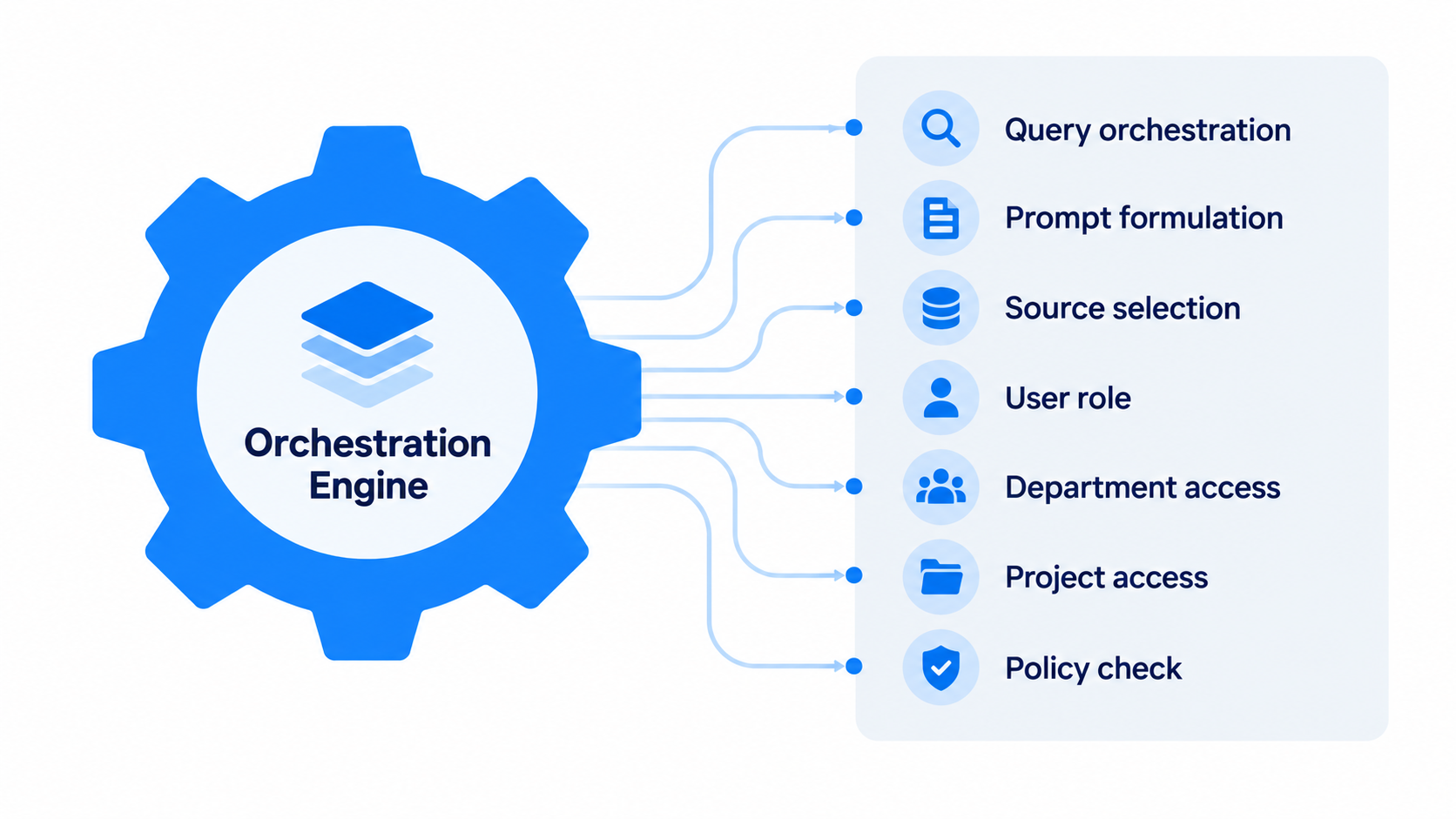
The orchestration engine acts as a gateway. Before a single document is searched, it checks the parameters of the request. Who is asking? What department do they belong to? What project is this related to? Are there specific policy constraints on this topic?
When an executive asks for Q1 marketing metrics, the decision engine does not just look for the words "Q1 marketing" across all company files. It evaluates the user's role, the department access required, and the policy checks that govern the data. It recognizes that the request is for a governed metric rather than a qualitative summary. The engine formulates the query based on these parameters, ensuring the AI understands the nature of the request before it attempts to generate a response. If the context is missing, the system does not guess. It prompts the user for clarification, turning a potentially dangerous hallucination into a structured, governed interaction.
Routing directly to the system of record
Most AI vendors pitch their ability to process unstructured data. But business decisions require both context and exact figures. The problem is that generative AI treats a mathematical figure like text prediction. It guesses numbers from narrative documents rather than calculating them from a verified system of record.
When a user asks for a specific metric, a standard AI tries to read through old presentation decks, meeting summaries, or emails to find a matching sentence. An active orchestration engine does the opposite. It recognizes that the user needs a hard number, skips the text files entirely, and routes the question directly to the company's reporting database, where the actual math is governed and stored.
Because the system integrates directly with these reporting layers, such as a Power BI semantic model, it pulls the actuals from the system of record. The user receives a secure, approved, and mathematically accurate answer instantly. This direct routing eliminates the risk of an AI confidently quoting an unapproved spreadsheet or an outdated forecast. The answer is not an estimation; it is the exact figure the business has already certified.
This is where the business opportunity becomes clear. McKinsey reports that 88% of organizations now use AI in at least one function, yet fewer than 40% have scaled it beyond a pilot. The organizations pulling ahead are the ones building the right foundation. The value comes from the architecture, not just the model. By connecting the AI directly to the governed business metric model, the business extracts immediate value from the data infrastructure it has already built.
Delivering answers based on role and department access
In a passive system, access is binary: you either have it or you do not. If an AI is pointed at a folder, anyone who can talk to the AI can usually extract information from that folder. This forces companies to restrict their AI entirely, locking it away from the most valuable corporate data out of fear.
An orchestration engine solves this elegantly. The right answer for a sales representative is often the wrong answer for a financial controller. The engine understands this distinction and applies access rights based on the user, role, department, project, and policy.
When the system routes the query, it ensures that approved data flows securely to the right destination. A sales representative asking about a discount receives the approved range they are cleared to see. The CFO asking the exact same question receives the revenue recognition impact. The AI delivers only approved, relevant, and governed information. This means the business can deploy AI widely without sacrificing security or overwhelming users with information outside their scope. The system scales because the permissions are built into the routing, rather than bolted onto the output.
Why the best corporate AI acts as a traffic controller
The market assumes that better models will eventually figure out corporate data on their own. That assumption ignores how businesses actually operate. A smarter model cannot guess which database holds the approved Q1 targets or which user is allowed to view them.
The goal of corporate AI is not to build a machine that reads everything. The goal is to build a machine that knows where the answers live. An active routing system delivers exactly that. It connects the right person to the right system of record at the exact moment a decision needs to be made.
The companies pulling ahead are not waiting for a more capable generic model. They are moving from passive search to active routing. By adopting operating layers and architectures like that of CorpGenie, they place an active orchestration engine between their models and their data. By doing so, they turn AI from a disconnected productivity tool into a governed asset that accelerates every decision the business makes.