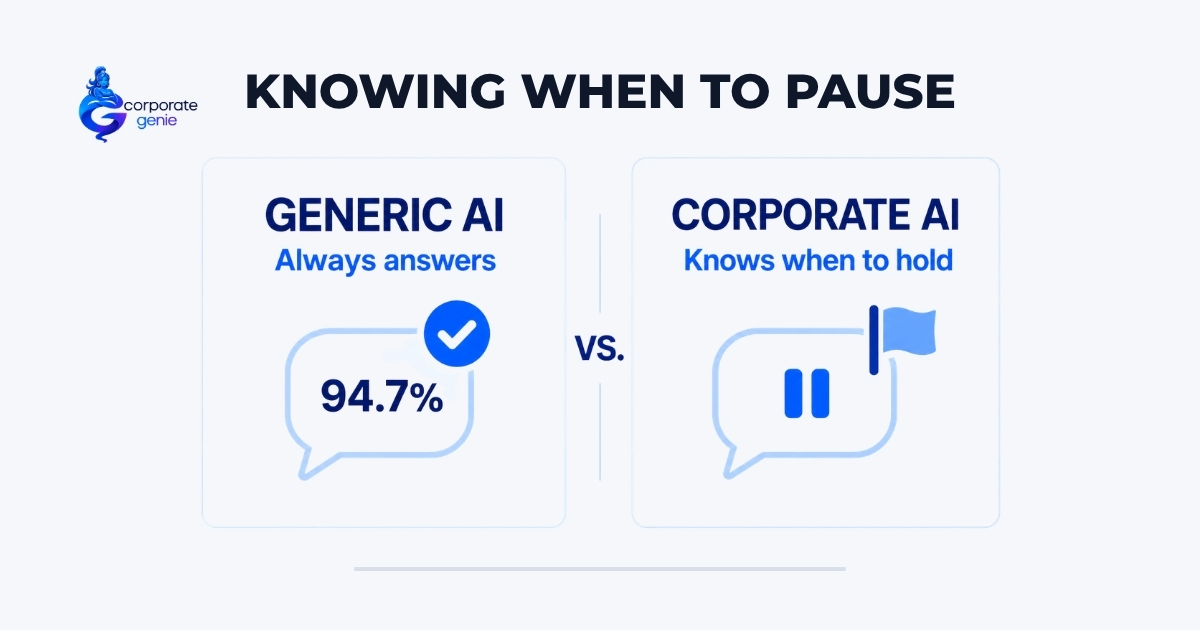
Most AI systems are built around a single goal: produce an answer. You ask a question, get a response. The model retrieves what it can find, formats it clearly, and returns it with consistent confidence. That capability is real and genuinely useful for a wide range of tasks.
But this can also create a structural problem in business settings. The reason is that some questions should not be answered (or not yet answered). This isn't because the AI model lacks capability; it's because the information behind the question can be incomplete, conflicting, or not yet governed well enough to act on.
A system that is optimized to always answer will never surface that. It will pick a source, resolve the conflict silently, and return something that looks reliable.
The business often will not know a decision was made on its behalf.
The answer that looks right but is not
Think about this scenario. A revenue operations manager asks the system what the renewal rate is for EMEA customers this quarter. Two source systems have been tracking this metric. Finance calculates it from invoiced contracts. Customer success calculates it from active accounts. The numbers are different because the underlying definitions are different. Nobody has established which one governs.
A generic AI tool retrieves both, picks the most recent file, and returns a number. The answer arrives quickly and it looks clean. It gets used in a report. Three weeks later, someone in the board meeting asks why the number does not match what Finance presented. The investigation traces back to a definition nobody had formally agreed on, applied through a system that had no way of knowing it mattered.
In this scenario, the model did exactly what it was designed to do. The problem is that producing an answer was, in fact, the wrong move. What the business needed first was to know that the gap existed, that there were two different numbers.
Why a gap is information the business needs to see
When a well-built corporate AI system sees conflicting sources for the same metric, the right response is not to immediately pick one. It is to surface the conflict clearly and hold the answer until it is resolved by someone with the authority to resolve it.
Some may think it's a limitation of the AI model. But no, it is a design choice that reflects how business decisions should work. Two sources producing different renewal rates for EMEA are not a retrieval problem. It's almost always a governance problem. This means that either the metric has not been owned or the definition has not been agreed on. The system that surfaces this inconsistency before it travels into a report has done a far more valuable job than one that quietly averaged the two figures and produced a quick answer.
So, the gap is the answer. And it should be routed to the person who can close it.
What happens when a detected gap becomes a campaign
Surfacing a gap is useful. But a system that only surfaces gaps and stops there has not solved the problem. It has just named it. The more powerful design is one where a detected gap becomes the start of a structured process to fill it.
When the system detects that a metric has no agreed definition, or that two sources are producing conflicting values, or that a key piece of context is missing or overdue for a refresh, it flags the issue, identifies a person who needs to be involved, proposes a specific next step, and creates a trackable request. The gap becomes a campaign or a series of action items: a human-guided effort to bring the missing knowledge into the governed system.
This is what separates a corporate AI system that stays the same from one that gets better with use. A system that only answers questions gets smarter as the model improves. A system that also detects and fills its own gaps gets smarter as the company uses it. Every campaign that closes a gap makes every future answer in that area more reliable. The knowledge base improves not because someone decided to run a documentation project, but because the system surfaced what was missing at the moment it mattered.
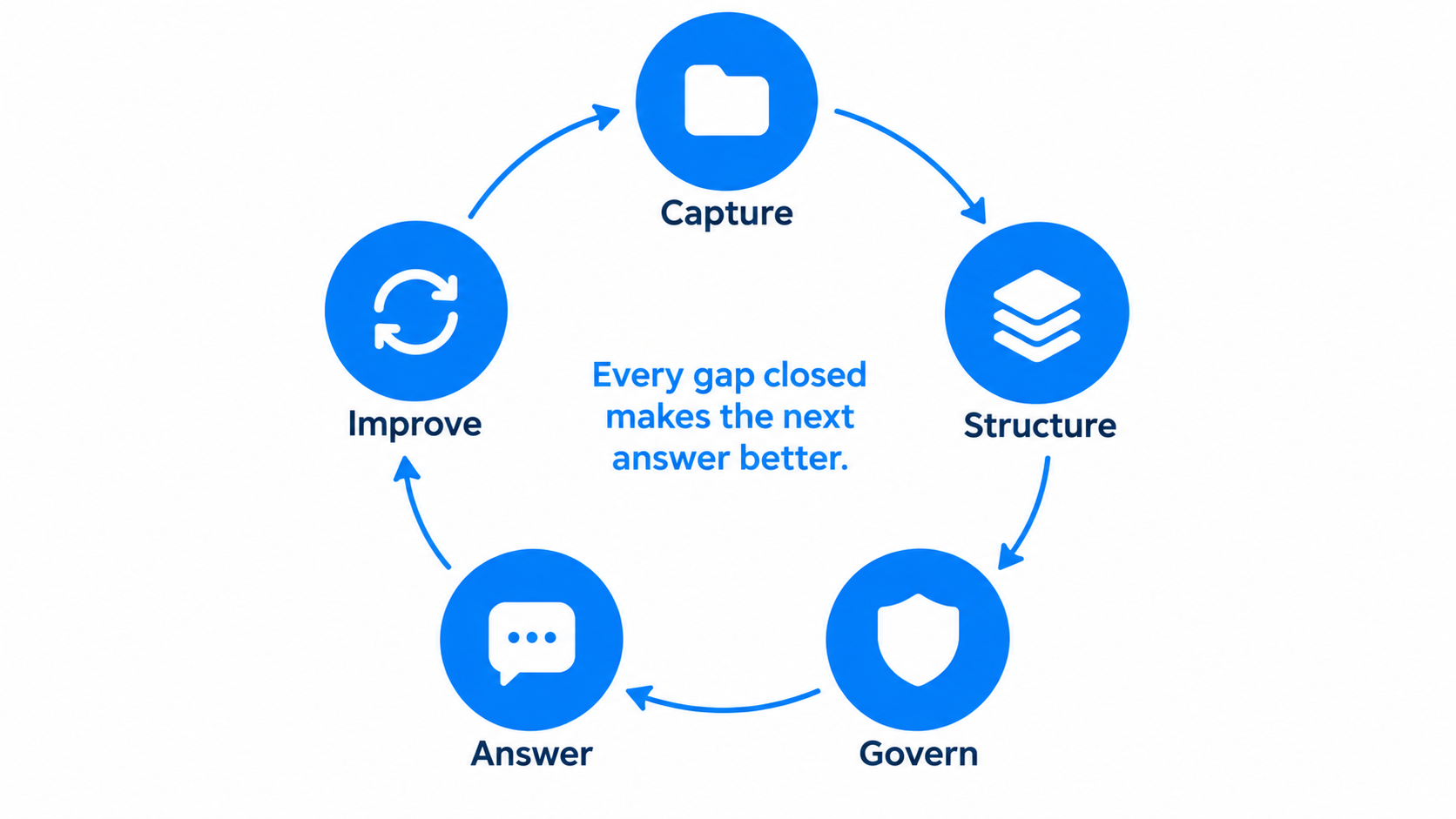
The loop: capture, structure, govern, answer, and improve
This self-improving dynamic follows a consistent sequence. The system captures knowledge from the sources it has access to. Then it structures that knowledge into governed, traceable assets. It governs who can see what and under what conditions. It answers from what it knows. And when it cannot answer well, it improves by surfacing the gap and routing it to the right person.
That last step is the most important and the one most corporate AI systems skip. They are built to capture, structure, govern, and answer. The improvement loop is left to humans to manage manually, which means it often does not happen at all. Knowledge gaps persist because no one is watching for them systematically. Outdated sources stay in circulation because no one flagged the refresh as overdue. Conflicting metrics get averaged or picked arbitrarily because no one established which source governs.
A system with the built-in improvement loop does not wait for a human to notice. It surfaces the gap at the moment it encounters it, and creates the conditions for someone to fix it.
The CorpGenie platform is designed around exactly this sequence: capture, structure, govern, answer, and improve. The improvement step is what closes the loop. The investment compounds because the system keeps learning, not just answering.
Corporate AI that improves itself will pull ahead
There is a practical implication here that most companies have not yet thought through. Two companies can run the same AI model on the same starting knowledge base and arrive at very different places within a year. The one that built the improvement loop into its system will have a knowledge base that is more complete, more current, and more governed. The one that did not will have the same gaps it started with, plus whatever new ones accumulated while the system was busy answering confidently around them.
The gap between them is whether the system knows what it does not know and does something useful with that information. It's never the model.
A corporate AI system that always answers is a tool. One that surfaces gaps, routes them to the right people, and closes them systematically is an asset that gets more valuable the longer it runs. That distinction is where the real return on an AI investment lives.