Our previous article established a hard truth about corporate data. Captured knowledge is a liability until it is refined into governed, specific knowledge. A business must establish clear ownership, freshness dates, and source hierarchies before it can trust an AI to answer questions.
This creates an immediate operational problem. A mid-market company cannot hire a team of human data janitors to constantly review thousands of documents and update freshness dates. If governance relies entirely on manual human review, the system will eventually fail.
This is exactly where Agentic AI belongs. The market treats autonomous AI agents as a futuristic tool for external execution. In reality, their most powerful application is internal maintenance.
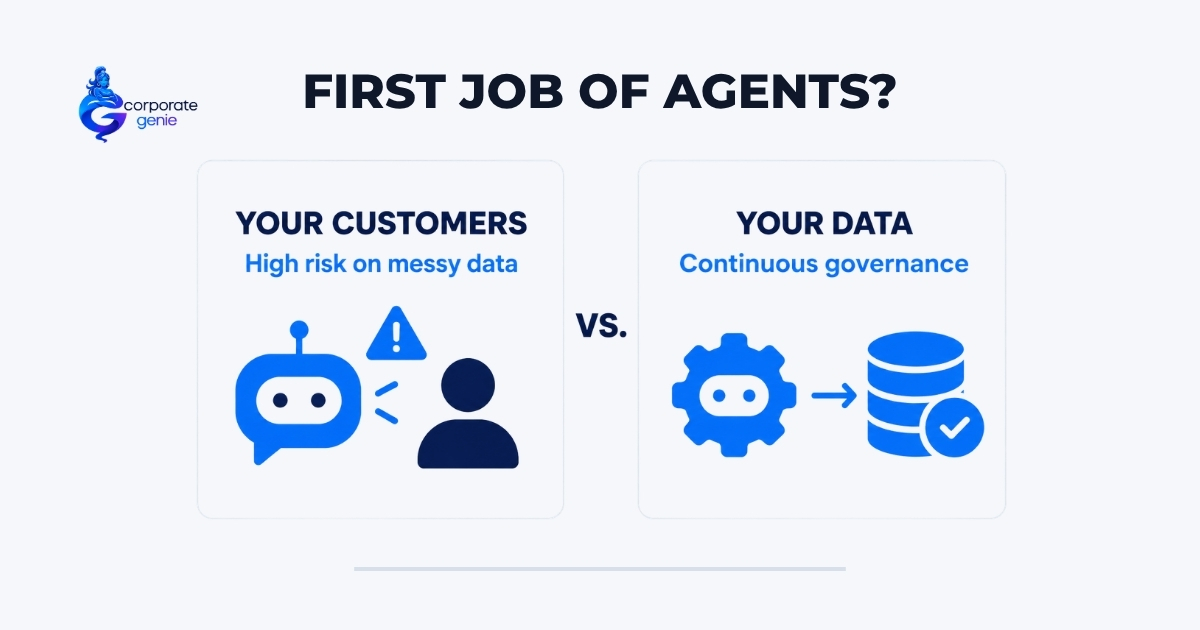
Why customer-facing agents fail on ungoverned data
The industry is currently hyping "Agentic AI" as autonomous bots that will execute complex business workflows, negotiate with vendors, or email customers directly. Software vendors are eager to sell agents that act on behalf of the business. In fact, Gartner predicts that by 2027, 40% of enterprises will decommission autonomous AI agents specifically due to governance failures.
This is a dangerous place to start. If a company currently lacks the operating layer to safely retrieve a basic internal KPI, allowing an autonomous agent to execute an external workflow is reckless. An agent pointed at an ungoverned corporate data blob will confidently execute flawed processes. It will send a quote based on an outdated pricing sheet or promise a delivery based on a rejected draft schedule.
Autonomous action requires absolute trust in the underlying data. Most companies have not built that trust yet. Therefore, pointing agents at external tasks skips the mandatory first step of enterprise AI.
Why the best first job for an agent is data governance
Instead of deploying agents outward to talk to customers, a mature corporate AI system deploys agents inward to talk to the data.
The actual, immediate value of Agentic AI is using it to continuously gather, enrich, refresh, and govern corporate information. Agents do the unglamorous, heavy lifting of data governance so human employees do not have to. They act as internal maintainers that keep the company's specific knowledge base current, complete, and useful.
When an AI system is only built to answer questions, it acts as a passive tool. When you introduce internal agents, the system becomes an active participant in keeping the business organized.
Automating knowledge maintenance with specialized agents
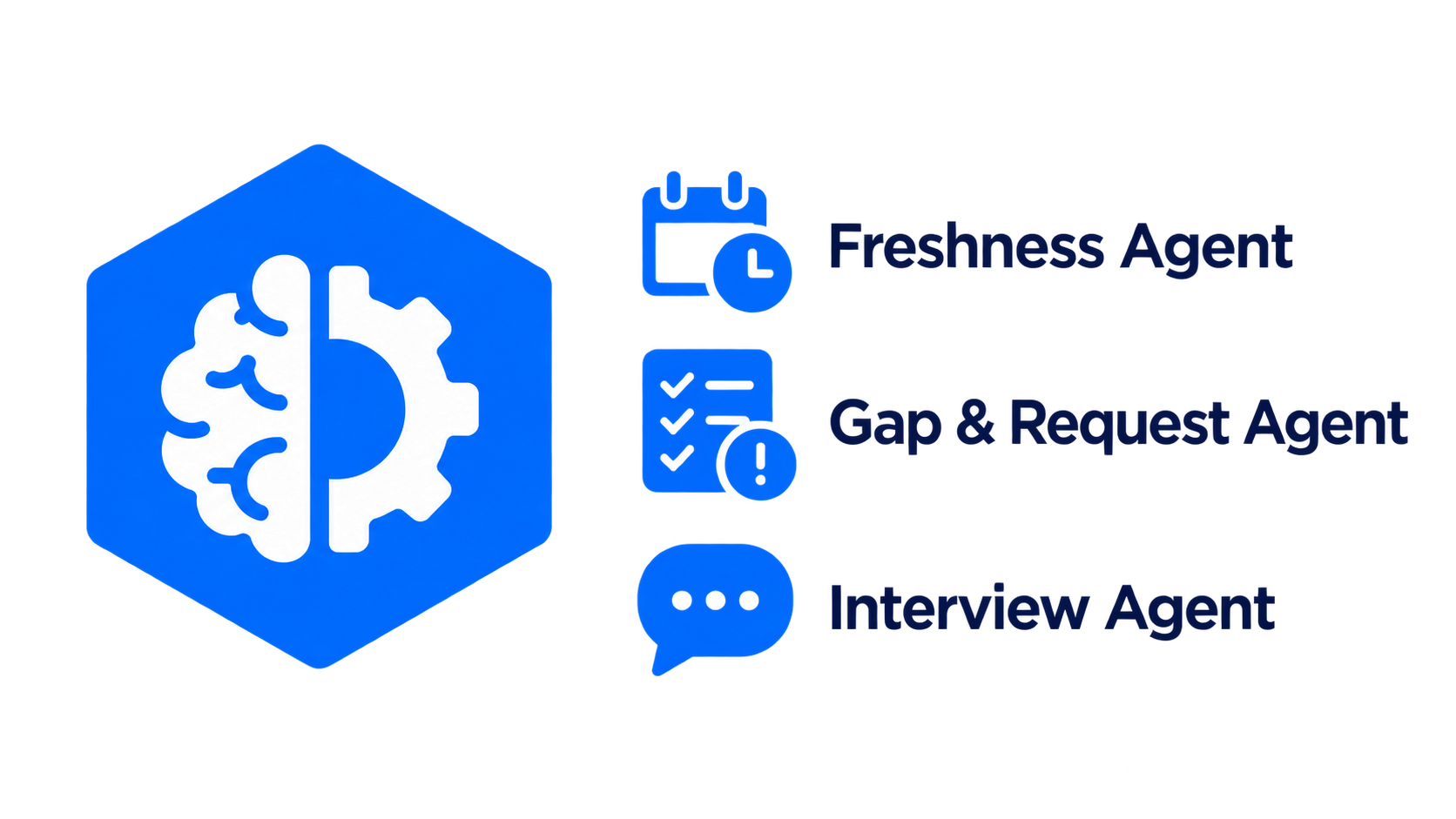
A well-designed operating layer does not use one massive agent to do everything. It deploys specialized agents with narrow, specific tasks.
Consider the problem of outdated documents. In a standard system, a policy sits in a folder until someone remembers to update it. In an agentic system, a dedicated Freshness Agent continuously monitors the knowledge base. When a document passes its expiration date, the agent automatically identifies the data owner and sends a scheduled request for a refresh.
When knowledge is missing entirely, the system deploys a Gap & Request Agent. If an executive asks the AI for a metric that has not been formally governed, the system does not guess. It flags the missing data and creates a trackable follow-up request for the responsible department head.
There is even a role for an Interview Agent. This agent proactively asks standard questions to business analysts and key stakeholders to extract tacit knowledge and convert it into documented corporate inputs.
The agentic AI control tower
These specialized agents do not operate randomly. They are orchestrated through an Agentic AI Control Tower.
The control tower sits between the raw corporate inputs (like loose documents and data warehouse exports) and the refined specific knowledge base. It deploys extraction agents to pull metadata and tags from unstructured files. It deploys discovery agents to identify new products, competitors, or metrics that need to be categorized.
This creates a continuous engine for data quality. The agents support business owners by constantly collecting and enriching information. The human stakeholders retain ultimate authority, but the agents handle the administrative burden of preparing the data for review. The result is a governed knowledge foundation featuring richer metadata, up-to-date policies, and clearly identified missing information.
A self-improving system outpaces a static one
Most corporate AI systems are built with a fatal flaw. They are designed to capture data, structure it, govern it, and answer questions, but they skip the final step of the loop: improvement.
A system without an improvement loop relies entirely on humans to notice when data is missing or broken. Because humans are busy with their actual jobs, those gaps persist. The system stays static and its answers slowly degrade over time.
Internal data agents close this loop. A system that detects its own gaps and deploys agents to flag them gets smarter with every use. Every time a Gap & Request Agent turns a missing metric into a new piece of governed data, every future answer in that area becomes more reliable.
Two companies can buy the exact same foundational AI model. The company that uses agents to continuously improve its internal data will eventually pull entirely ahead of the company that does not. The difference is never the model. The difference is the system built to maintain the truth.