
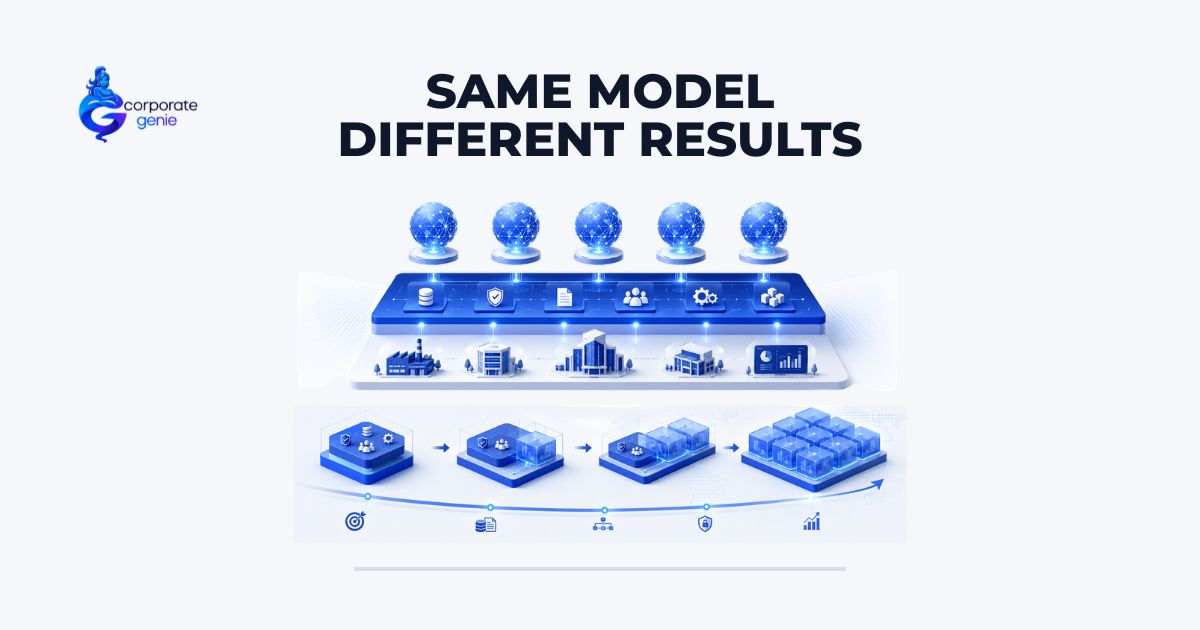
There is a common assumption about AI right now. The thinking goes that AI may not be delivering as promised yet, but the models keep improving, so the results will soon follow. Wait for the next version, and the problem solves itself.
It is a reasonable assumption. But it is also the wrong one. It’s true that the models are improving faster than almost anyone expected. But that improvement is not flowing through to enterprise results. Understanding why this is happening reveals where the real advantage should be built.
Model quality is becoming a commodity
The performance gap between the leading models has narrowed sharply. Stanford’s 2025 AI Index found that the gap between the top model and the tenth-ranked model shrank from 11.9% to 5.4% in a single year. The gap between the top two models was just 0.7%. In other words, capable models are now available from many providers, often at a fraction of the cost they carried a year earlier.
For a business, this is good news. You no longer need to bet on one model or chase the newest release. Strong models are becoming a commodity you can buy, swap, and upgrade as the market moves.
Which raises the real question. If everyone can access models of similar strength, the model can no longer be the thing that sets one company’s AI apart from another’s. So what does, then?
Why AI scores better in demos and worse in companies
Here is the number that matters most. Research in 2026 found that enterprise AI systems show roughly a 37% gap between how they score on lab benchmarks and how they perform in real-world deployment. The model that looks excellent in a demo does noticeably worse once it is working inside an actual company.
This gap is not a model problem. The model performs the same in both places. What changes is everything around it. In the lab, the model is handed clean, well-framed questions. In real-world companies, the model meets messy data, conflicting documents, unclear ownership, and questions that depend on who is asking and what they are allowed to see.
Think of a skilled surgeon. They are only as safe as the information in front of them. Hand that surgeon an outdated chart, the wrong allergy list, or notes that belong to a different patient, and skill alone will not prevent the mistake. The surgeon has not become less capable. The information around them has failed them.
A general-purpose AI model inside a company is in the same position. It is capable. But it is only as good as the context it is given, and in most companies that context is incomplete, out of date, or contradictory. A better model reads the same bad chart. It just reads it more fluently.
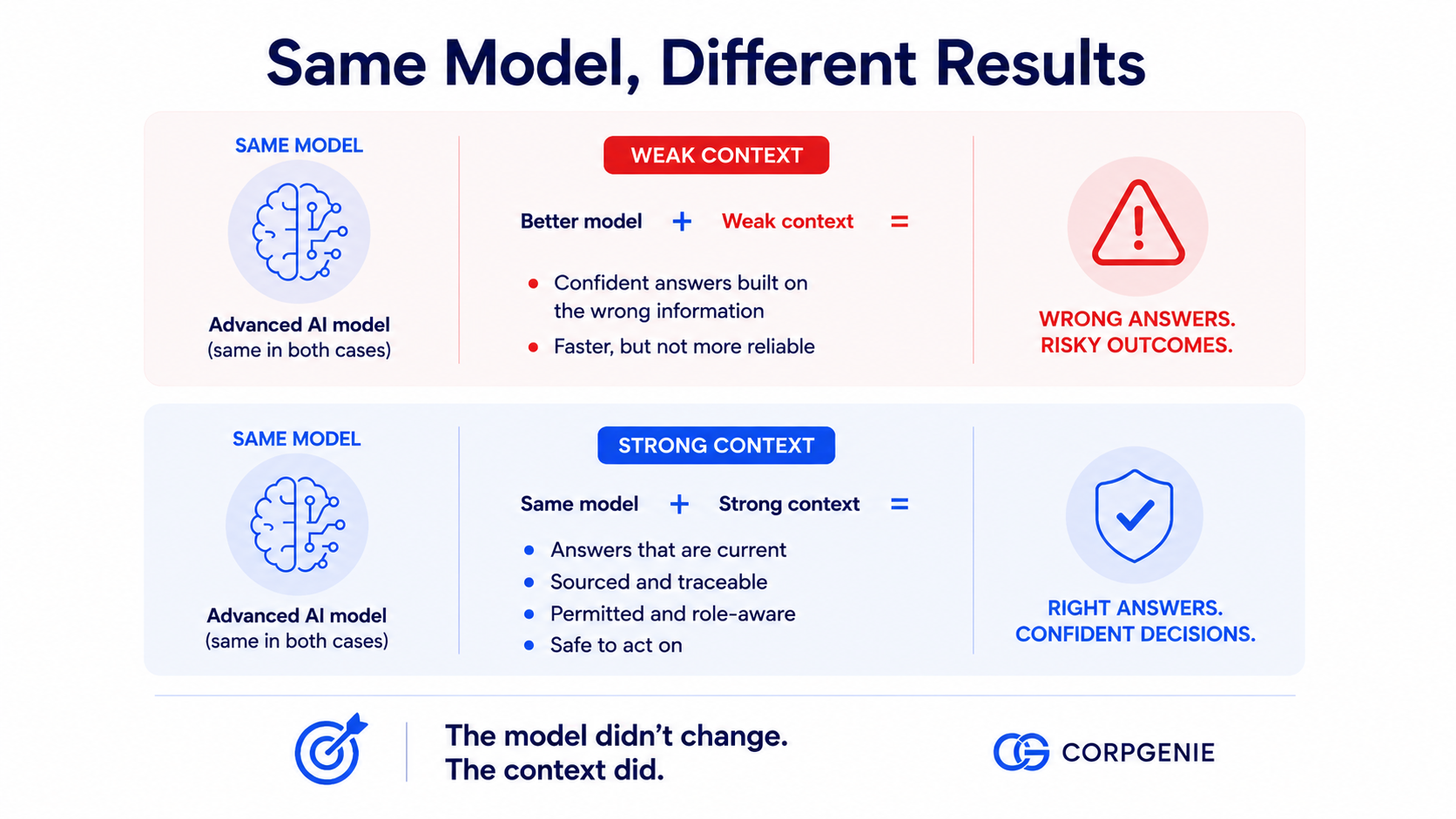
Leading companies have drawn the obvious conclusion. A better model does not close that 37% gap, because the model was never what created it. The gap is in the missing context. And context is something the company builds, not something it buys with the next upgrade.
What building context means
Context is an abstract word, so let’s be concrete about what it means and includes. In practice, the companies investing in context are building four things, the same operating layer we have covered in this series.
- Trusted sources, so the system knows which information is current and authoritative, and which has been replaced.
- Role-aware permissions, so the answer fits the person asking and respects what they are cleared to see.
- Workflow integration, so the AI supports real decisions in planning, approvals, reporting, and review.
- Accountability, so every answer can show where it came from and how current it is.
None of this comes from the model. All of it comes from the company. A newer model running on the same weak context produces the same weak results (only faster and more convincingly). The same model running on strong context produces answers a business can actually trust and act on.
Context is the part you own
There is an even more important reason this matters for the years ahead. Models come and go. The one you use today will be replaced within a year, probably by something cheaper and stronger. If your advantage lives in the model, you don’t really own it, and it resets every time the market moves.
Context works the other way. The trusted sources, the permissions, the workflows, the accumulated judgment about how your company operates, all that stays with you when the model underneath gets swapped out. You can change the engine without losing the knowledge the company has built around it.
This is what makes context compound. Every improvement to it makes every future answer better, across every team and every model you will ever run. The investment doesn’t reset. Instead, it accumulates. The companies building this now are creating an advantage that gets harder to catch over time, precisely because it is theirs and not the model’s.
The model is the engine, not the destination
Better models are genuinely good news. They make everything built on top of them faster and more capable, and they keep getting cheaper. But waiting for the next model to deliver enterprise results is waiting for the wrong thing.
The companies that will lead in AI are not the ones running the newest model. They are the ones who built the context that makes any model understand their business. This work is already available to every organization right now, and it starts the moment you stop waiting for the model upgrade and start building the layer around it.