Organizations spend money on corporate AI, assuming their existing security infrastructure handles the risk. The logic feels sound and makes sense: if an employee cannot open a SharePoint folder, the AI assistant cannot read the files inside it.
However, this assumption is currently driving one of the largest security crises in corporate AI.
To understand why, we have to look at how company data behaves, how generative AI breaks traditional security models, and why the shift to "answer-level security" is the only viable path forward for true corporate AI.
Why Permission Sprawl is an AI Liability
Most companies suffer from severe permission sprawl. Over the years, files are shared broadly to save time, employees change roles without losing old access, and temporary project folders become permanent fixtures on the network.
Recent security audits of corporate environments, such as Varonis's data risk research on Microsoft 365 Copilot deployments, reveal just how exposed these networks are. Their findings indicate that the average corporate tenant contains tens of millions of unique permissions, with roughly 10% of a company's total data exposed to all employees.
Before AI, this was a dormant risk. Finding a restricted financial spreadsheet or an unsecured client list required an employee to already know it existed, navigate to the exact directory, and open it. It was protected by "security through obscurity."
Now, natural language acts as a universal skeleton key. A user can simply ask a generic AI assistant a broad question, and the system will instantly retrieve and summarize every file the user technically has access to—including an executive compensation draft sitting in an unrestricted legacy folder. AI does not create new vulnerabilities; it simply weaponizes the broken permissions an organization already has.
Document-Level Access vs. Answer-Level Security
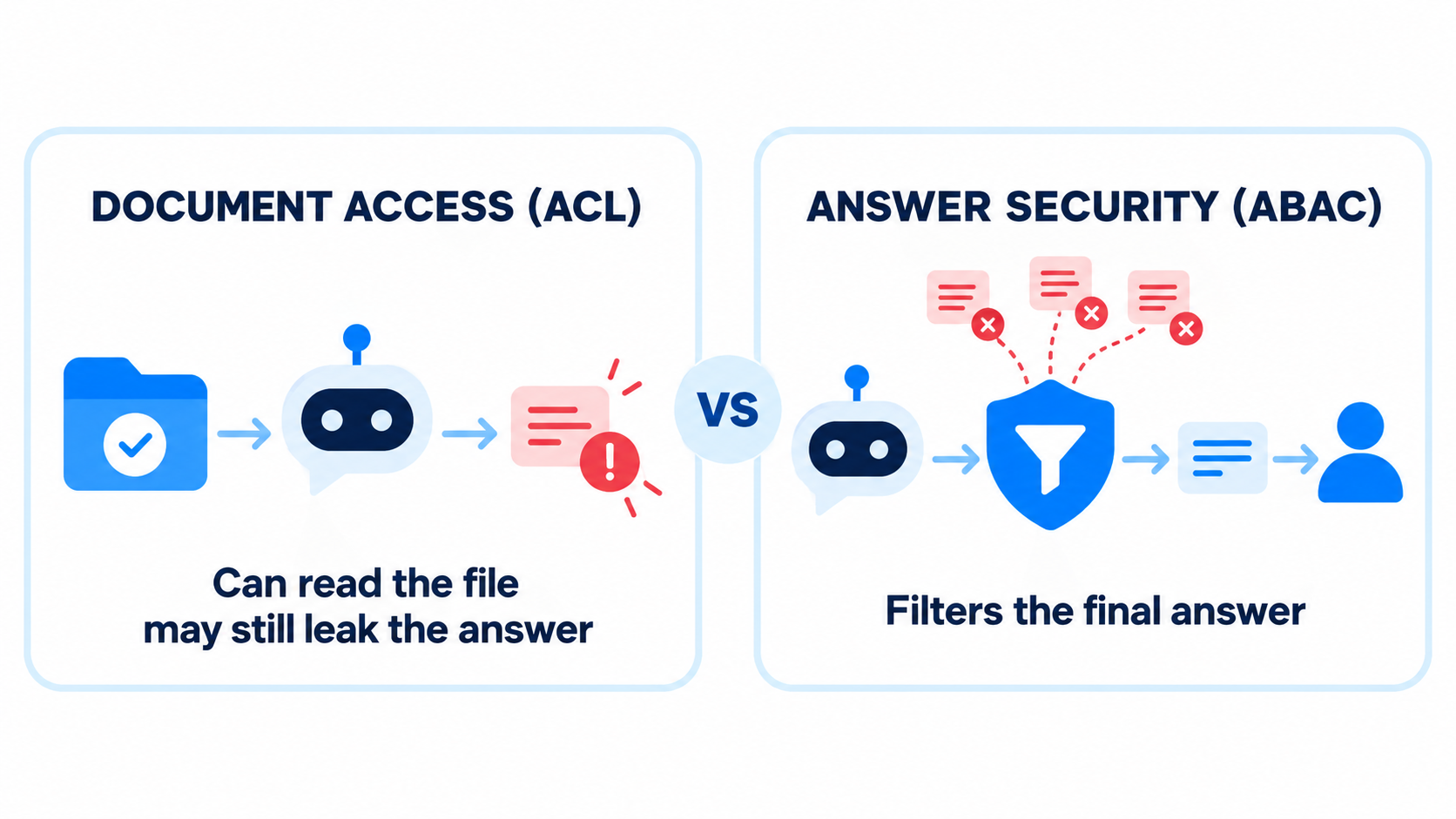
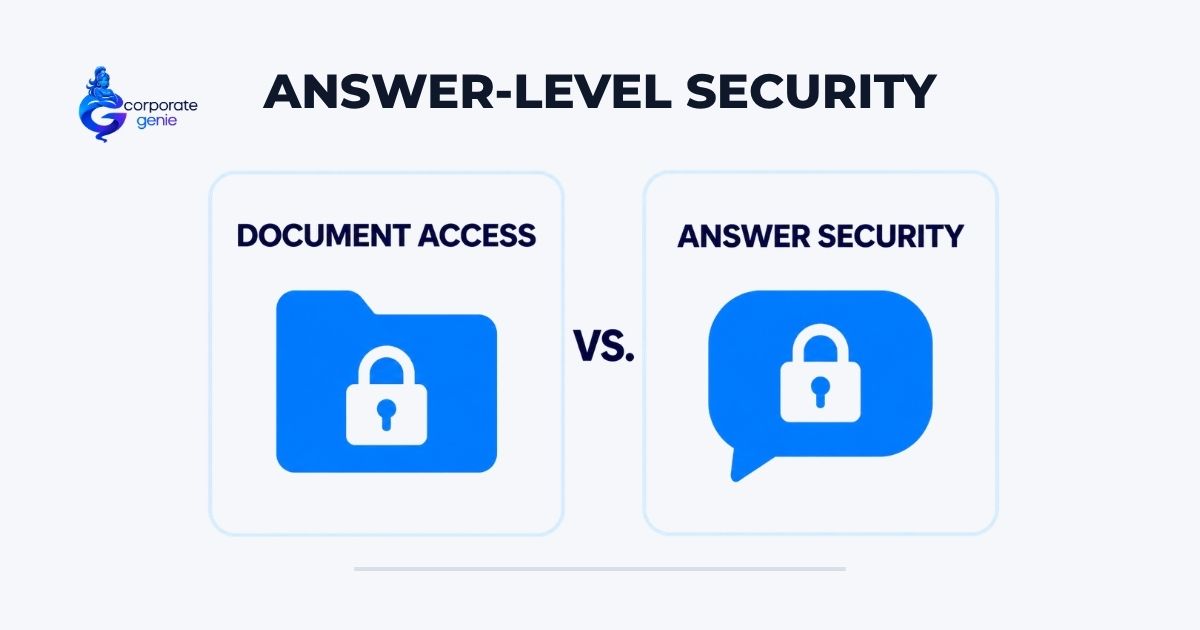
The core architectural failure is treating AI search the same as traditional file storage. File access and answer authorization are two fundamentally different clearances.
Standard Access Control Lists (ACLs), like inherited SharePoint folder permissions, are static and binary. You either have access to the document, or you do not. But generative AI creates a completely new problem: synthesis.
As we have noted previously, a junior analyst may be permitted to open a dataset and still not be the right recipient of a synthesized answer that reveals individual compensation patterns.
Consider a standard Retrieval-Augmented Generation (RAG) pipeline relying solely on document-level permissions. An analyst has legitimate access to an aggregate departmental budget (for expense tracking), and legitimate access to a public team roster (for headcount). Because both files are permitted, the AI reads both. However, if the analyst now asks the AI, "How much does the engineering director make?", the AI synthesizes the two files, cross-references the headcount against the budget, does the math, and returns the individual compensation.
The AI didn't bypass security. It followed document-level security perfectly—and it still leaked restricted data. This happens because the system confused who is cleared to see a document with who is cleared to receive a synthesized answer drawn from it.
How Generative AI Triggers the Inference Risk
This vulnerability is known in the cybersecurity industry as an inference risk. Global security frameworks are aggressively updating to address it. The OWASP Top 10 for Large Language Model Applications (LLM06: Sensitive Information Disclosure) explicitly warns that AI models can easily infer and leak restricted data through aggregate summaries if organizations rely solely on inherited folder permissions.
When a model is given blanket access to everything a user can technically open, it lacks the context to know which inferences are safe to make and which cross a compliance boundary. It treats all accessible text as raw material for answering the prompt. In a consumer chatbot, that is a feature. In a corporate environment, it is a massive liability.
How the Operating Layer Fixes This: RBAC and ABAC
To fix this, corporate AI must shift from static document ACLs to dynamic security controls enforced at the orchestration layer. In a true corporate AI operating layer, security is not only about what the AI can read; it is about what the AI is allowed to say.
This is exactly where the architecture of the Corporate AI Operating Layer diverges from generic RAG.
When a user asks a question, the platform's Orchestration Engine intercepts the query before it ever reaches the generative model. The "Security & Dataflow" module applies two critical layers of defense:
Role-Based Access Control (RBAC): Evaluates whether the user holds the correct formal title or department access to request this category of information.
Attribute-Based Access Control (ABAC): Evaluates the situational context in real time. It checks project access, policy constraints, and the sensitivity of the combined data sources.
This dynamic filtering dictates the system's approved routing, ensuring the query only hits trusted, allowed sources.
Crucially, it enforces governed response rules on the final output. If a manager asks a question that requires combining a public team roster with a restricted finance dashboard, the system evaluates the combined risk. The system can dynamically redact the sensitive output, state that the user lacks the required clearance, or route the query for human review. It guarantees that users receive only approved, relevant, and governed information.
Furthermore, because corporate security requires complete traceability, the operating layer logs every query, decision, and response to an immutable audit trail. If an answer is challenged, the business knows exactly who asked the question, which sources were queried, and which ABAC policies cleared the output.
Why Prompt Customization Cannot Solve Security
Many IT teams attempt to patch inference risks by adding custom instructions to their AI prompts, instructing the model not to discuss salaries or sensitive data. But as we explored in our analysis of why prompt engineering and customization are not real corporate AI strategy, this is a losing battle.
Customization changes what the AI says, but it does not change the underlying architecture of what the AI is allowed to do. A custom GPT or a fine-tuned model still wants to produce an answer, and it has no deterministic logic for when to refuse or escalate based on a compliance violation. As we discussed in The Infrastructure Trap, technical controls check the output, but business governance must check the decision.
The operating layer sits outside the model. If a requested answer violates an ABAC policy, the operating layer stops it. The model does not get to bypass the security gateway using a clever prompt injection.
Governing AI at the Answer Level
Security is the ultimate corporate blocker for AI adoption. The companies that successfully scale AI over the next three years will be the ones that realize folder permissions were built for file storage, not generative intelligence.
By building an operating layer that applies dynamic RBAC and ABAC at the answer level, organizations can finally deploy AI that is safe enough to run the business. They move past the illusion of security through obscurity and build a system where the AI is not just an ungoverned reader of documents, but a governed participant in the business.