
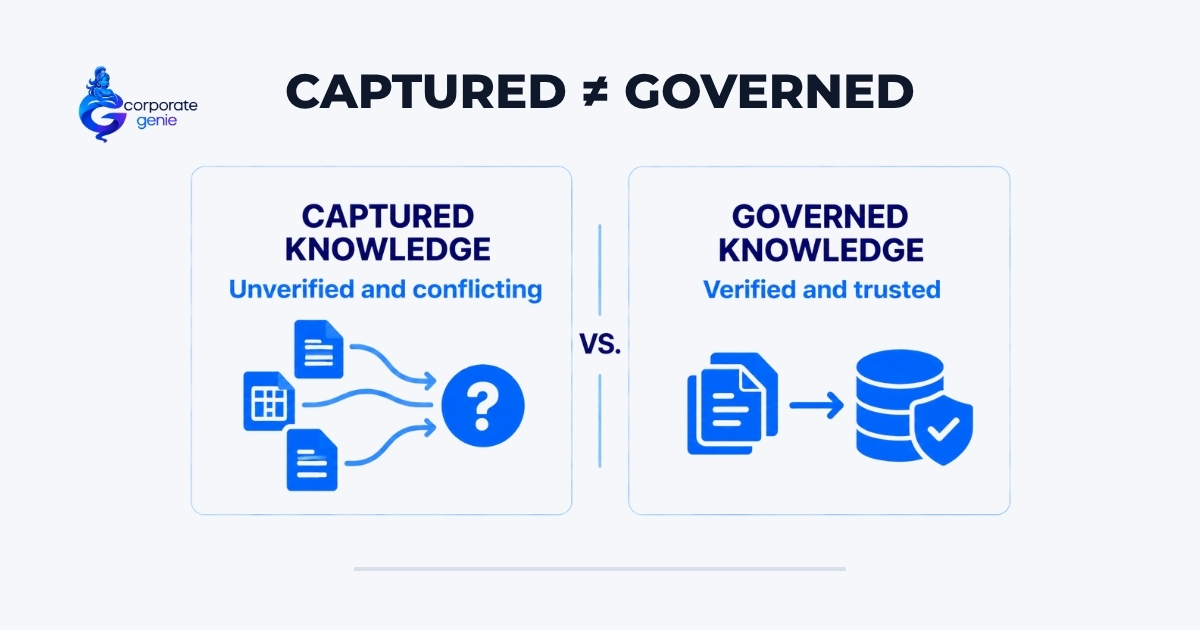
A common misconception in enterprise AI is that captured knowledge is ready for production.
Organizations spend months connecting data lakes, indexing SharePoint repositories, scraping internal wikis, and loading gigabytes of operational text into vector databases. The technical plumbing functions as intended: documents are chunked, embeddings are generated, and similarity search retrieves relevant passages in milliseconds.
Yet the moment an employee or an automated agent queries that data for an operational decision, the architecture breaks down.
That is because captured knowledge is merely recorded text, while properly governed knowledge is verified operational truth. Confusing the two is the primary reason enterprise AI pilots impress leadership in a demo room, but then quietly fail when exposed to real-world daily business operations. MIT Project NANDA’s study on enterprise generative AI confirms this exact failure pattern: over 90% of enterprise generative AI pilots deliver zero measurable return, not because the models fail to write, but due to poor data quality, inadequate risk controls, and unclear business context.
The Illusion of the Corporate BLOB
When companies begin an internal AI initiative, they usually build what can be described as the Corporate BLOB: the Big Library of Business.
The BLOB acts as a centralized repository that stores and manages large volumes of structured and unstructured information across the organization. It collects every accessible piece of corporate history: master service agreements, meeting recordings, Slack transcripts, quarterly presentations, ERP data exports, and policy memos. From an engineering standpoint, assembling this repository feels like progress. The search bar returns rich paragraphs, and the retrieval metrics look pristine.
The failure here lies in mistaking retrieval relevance for business authority.
Semantic search operates by measuring cosine similarity across high-dimensional vector spaces. It evaluates whether words and phrases resemble each other in meaning. It cannot evaluate whether a document was formally approved, whether a memo was superseded last week, or whether the reader has clearance to see the conclusion drawn from it.
An ungoverned AI looks at the entire Corporate BLOB as an undifferentiated pool of equal facts. To the model, an unapproved draft spreadsheet uploaded by an intern carries the same mathematical weight as an audited financial report signed by the CFO.
When Three Valid Documents Produce One Operational Failure
To understand why this distinction matters, consider a routine operational query at a mid-market equipment manufacturer.
A procurement manager asks the internal AI: "What is our agreed delivery lead time for a key supplier?"
The retrieval engine scans the Corporate BLOB and finds three documents containing a lead time:
- A master agreement from two years ago: A formal, signed contract specifying a 60-day standard lead time.
- A revised schedule attached to an email from March: A renegotiated agreement establishing an expedited 35-day lead time.
- A planning spreadsheet updated last week: An unapproved scenario model created by someone in operations testing what would happen if lead times dropped to 14 days.
All three documents were successfully captured. Each file mentions the supplier, the parts, and delivery timelines.
Now, what does an ungoverned AI do with this captured knowledge?
Because the model lacks business context, it returns the most recently modified file, because recency is the only signal it has. Alternatively, it could average the numbers and report a clean, confident, and fabricated figure of 36 days.
The procurement specialist acts on that answer, promises delivery to an assembly plant based on a two-week turnaround, and halts the production line when the valves fail to arrive.
The model did not hallucinate. The vector database did not malfunction. The failure occurred because the system possessed captured knowledge without a governance layer to interpret it. Nothing in the stack indicated that the March email carried active authority, that the spreadsheet was an unverified sandbox draft, or that the original contract remained the legal baseline.
The Four Requirements of Governed Knowledge
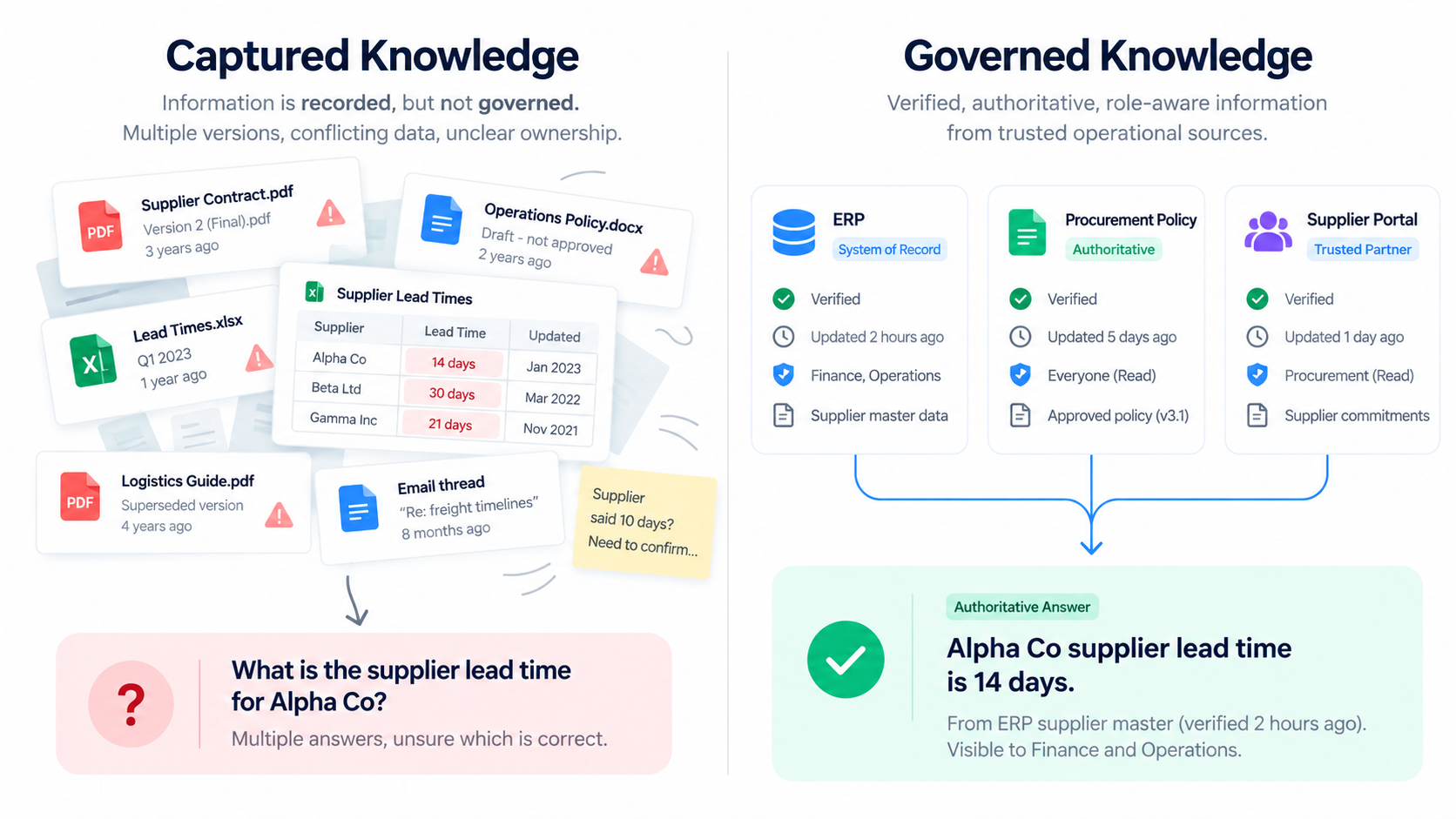
Transforming raw captured data into governed corporate intelligence requires four architectural disciplines. None of these exist natively inside a basic retrieval pipeline.
1. Source Authority and Precedence
Knowledge must carry explicit organizational authority. When two sources disagree, the architecture must know in advance which source wins. A draft policy memo cannot outrank an active corporate handbook. A sales representative's call notes cannot override an executed contract.
Assigning authority is an operational judgment, not an engineering parameter. As explored in our analysis of who should own corporate AI internally, someone with standing in the business must establish the source hierarchy before the conflict occurs, not during an executive meeting where teams are already disputing numbers.
2. Lifecycle and Freshness Verification
Information decays rapidly. A joint Harvard Business Review and Cloudera study on data architecture found that only 7% of organizations consider their data completely ready for AI. A major reason for this is that a captured document appears permanent to a vector index, but business conditions change weekly. Governed knowledge attaches explicit verification timestamps, scheduled refresh cycles, and designated owners to every asset.
If a document exceeds its review date without sign-off from its owner, the operating layer must downgrade its reliability score. It must never allow a stale policy to quietly masquerade as current reality simply because the file still sits in an open folder.
3. Answer-Level Permission Boundaries
File access and answer authorization are two fundamentally different clearances.
Standard access controls determine whether a user can open a folder. Answer-level governance determines whether a user is permitted to receive a synthesized conclusion drawn from multiple documents. Global security frameworks, such as the OWASP Top 10 for Large Language Model Applications (LLM06: Sensitive Information Disclosure), increasingly warn against relying solely on document-level access, as AI models can easily infer and leak restricted data through aggregate summaries.
A manager may have legitimate access to a team roster and an aggregate departmental budget, but the AI must not combine those sources to expose an individual colleague's compensation package. Governed knowledge applies policy checks before retrieval, during synthesis, and at the output stage, ensuring that sensitive corporate inferences do not leak through unrestricted answers.
4. Strategic Refusal Over Confident Guesswork
An ungoverned AI is programmed to answer every prompt. When confronted with conflicting data or missing authority, it guesses, averages, or selects the most recent file to avoid silence.
A governed system treats refusal as a critical feature. As detailed in our breakdown of why corporate AI should sometimes refuse to answer, the most valuable response to a conflicting query is not a speculative number. It is an explicit statement that two authoritative sources disagree, paired with an automated escalation to the metric owner who can resolve the discrepancy.
The Path from Ingestion to Governance
Solving the knowledge gap does not require building a massive, company-wide data catalog before launching your first AI use case. Attempting to classify every piece of corporate data upfront is the fastest way to fall into the infrastructure trap in corporate AI, spending capital on pipeline components while business value remains flat.
The practical path starts small and complete:
- Select one repeated decision: Focus on a bounded operational workflow, such as vendor lead-time verification, pricing discount thresholds, or quarterly variance commentary.
- Identify the authoritative source: Name the single document or system of record that settles each question within that workflow.
- Establish the review cadence: Assign a named human owner responsible for verifying that the source remains current.
- Deploy active maintenance: Instead of burdening analysts with manual documentation audits, deploy agents to continuously monitor freshness, detect discrepancies, and route missing context to human owners.
Captured knowledge gives an AI system raw material to read. Governed knowledge gives an organization an asset it can safely run on. The companies that succeed with corporate AI are not those with the largest document indexes, but those that build the operating layer required to make their knowledge dependable.